Award-winning interior design websites teach valuable lessons about craft: careful typography, thoughtful pacing, refined motion and attention to detail. But website awards judge creativity and execution, not whether a site brings the right inquiries or ranks in Google. Some of the most celebrated sites are slow, hard to navigate on a phone or nearly invisible to search engines. The best approach is to borrow the craft and keep the clarity.
Here is what the awards reward, what that means for a design studio and how to use award winners as inspiration without losing sight of your goals.
What website awards actually judge
Programs such as Awwwards, CSS Design Awards and the Webby Awards evaluate websites on criteria like design, usability, creativity, content and technical execution. Juries are usually made up of designers and developers. They tend to reward work that pushes boundaries: unusual layouts, inventive interactions and technical achievement.
That is valuable for the industry, but it is a different goal from running a design business. A jury is not deciding whether to hire you for a renovation. A homeowner on a phone during a lunch break is.
Lessons worth borrowing
Award-winning sites often excel at things every studio can learn from:
- Typography: confident type at generous sizes, carefully spaced.
- Pacing: projects revealed with rhythm, alternating wide images, details and text.
- Restraint: fewer elements, each given room.
- Transitions: smooth movement between pages that makes a site feel crafted.
- Details: hover states, image loading and small touches that show care.
These are worth studying closely. Our guides to choosing fonts and website design trends worth following explore several of them.
Habits to approach carefully
Some award-winning habits can work against a design studio:
- Experimental navigation: hidden menus, horizontal scrolling or unusual controls that make visitors work to find basic information.
- Heavy animation: long intro sequences and effects that delay reading.
- Slow loading: large video and complex scripts that take seconds to load on mobile data.
- Little text: beautiful visuals with almost no words, which leaves search engines and AI tools with nothing to understand.
- Desktop focus: designs that shine on a large screen but feel cramped or broken on phones.
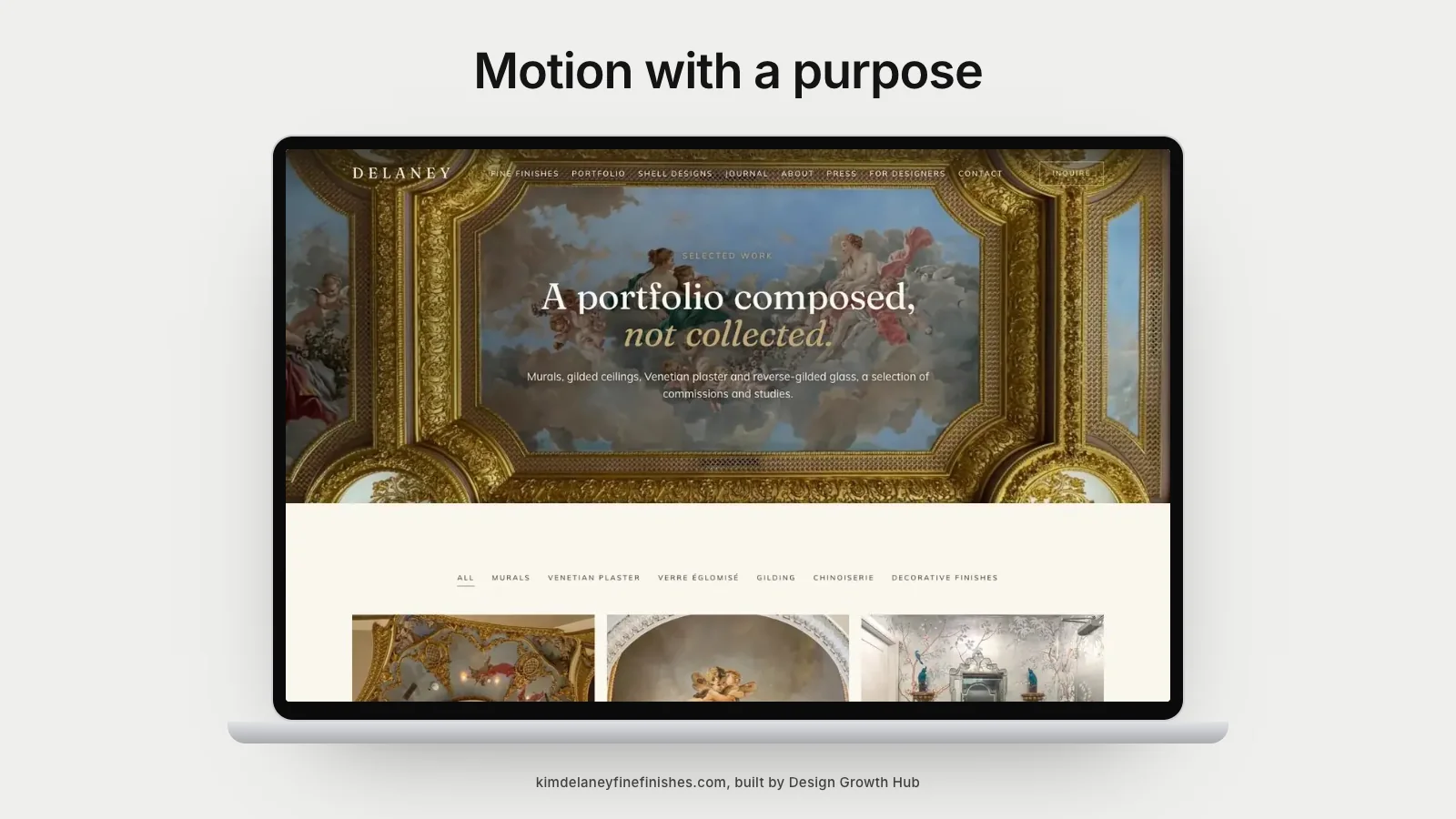
Our article on whether animated interior design websites help or hurt discusses the balance between motion and usability.
What clients notice instead
Prospective clients do not judge your site against award criteria. They want to understand quickly what you do, see work like theirs, feel confident in you and get in touch easily. A site that does those things beautifully will serve your studio far better than one that wins applause but leaves visitors confused.
That is not an argument against ambition. It is an argument for ambition in service of clarity.
Finding the balance
The best studio websites combine award-level craft with practical clarity. They might use a beautiful page transition, but the menu is still obvious. They might reveal images gently as you scroll, but text appears immediately. They might have a striking opening screen, but it says plainly what the studio does and where.
When reviewing an award winner for inspiration, ask:
- Could a first-time visitor find the contact page within seconds?
- Does the site load quickly on a phone?
- Is there enough written content to explain the work?
- Would this design flatter my photography, or compete with it?
Speed is part of the craft
One lesson from the very best award winners is often overlooked: the strongest of them are fast. Behind the visual polish there is careful engineering, with images sized precisely, scripts loaded only when needed and animations that run smoothly even on modest phones. If you admire a site's motion, notice whether it also loads quickly on your phone. If it does not, the craft is incomplete, and copying it would bring the same problem to your studio.
For a design studio, speed is especially important because portfolios are image-heavy. Our guide to using images on an interior design website explains how to keep photography sharp without slowing pages down.
Awards and credibility
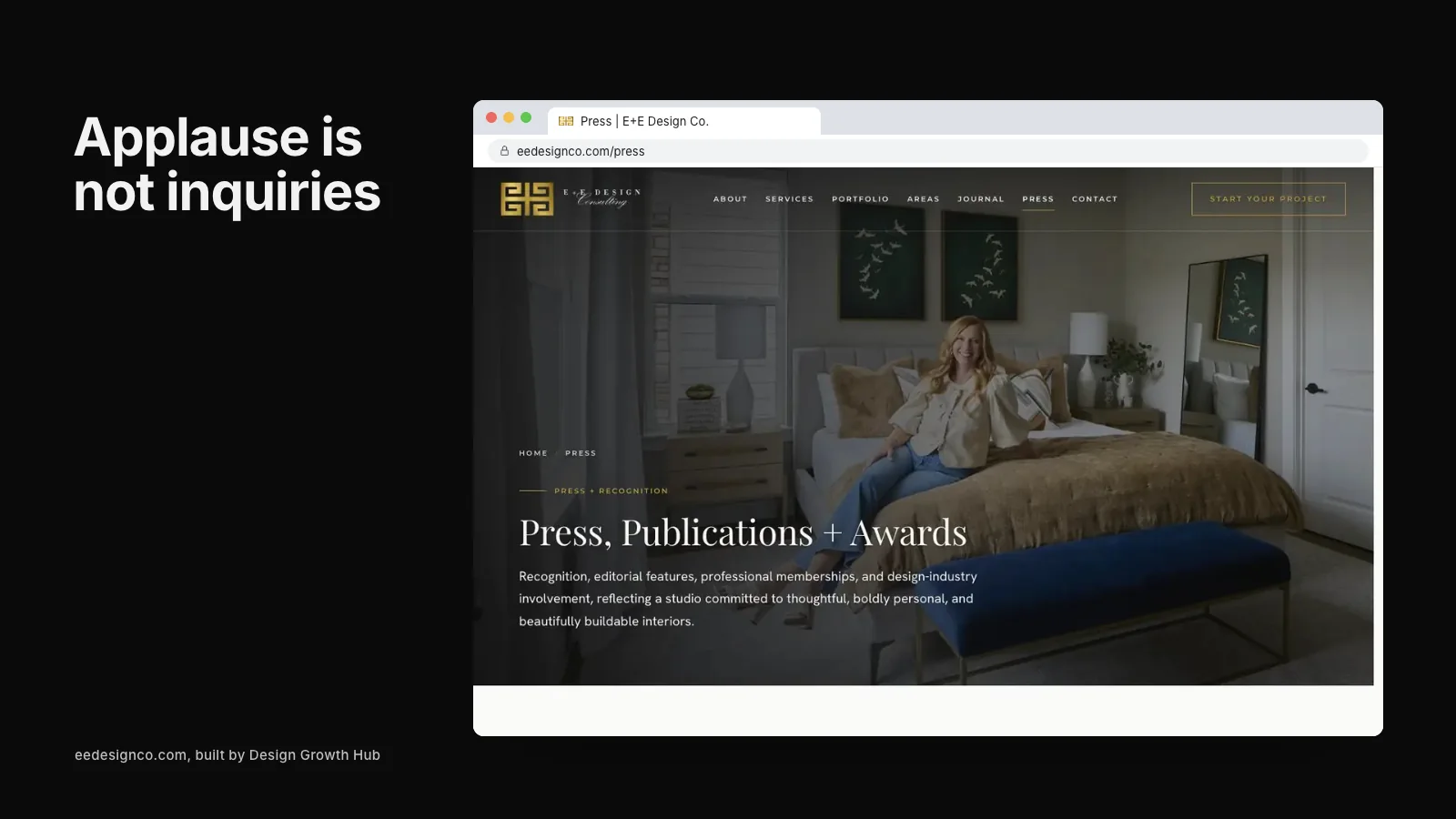
Some studios like the idea of winning a website award to add credibility. It can be a nice addition to a press page, especially for studios with a design-forward audience. But most homeowners will be more persuaded by your projects, reviews and published work than by a web design award. Our article on building trust before a client contacts you covers the proof points that carry the most weight.
Design awards that matter more
For interior designers, recognition within the design industry usually matters more than website awards: showhouse participation, magazine features, design competitions and professional honors. These belong on your website, presented calmly. Our guide to press features and AI search explains how to present them so they also help visibility.
Using award winners as inspiration
Treat award galleries as one source among many. Collect examples of details you admire, note why they work and adapt them to your brand. Our article on where to find interior design website inspiration describes how to build a useful collection without copying.
Where this fits in a full build
A site that feels crafted still needs clear structure, strong content and solid search setup. Our guides to creating an interior design website step by step, what an interior design company website should include, building a portfolio website and the website guide for growing studios cover those foundations. If you sell products, interior design ecommerce websites has notes on balancing creativity with a smooth shopping experience.
Our website redesign service aims for that balance: crafted, considered design that still makes the next step obvious. If you would like to know how your site compares, request a studio review.
Build your visibility foundation
Design Growth Hub helps interior designers build the visibility foundation behind high-value discovery.
Request a Studio Review