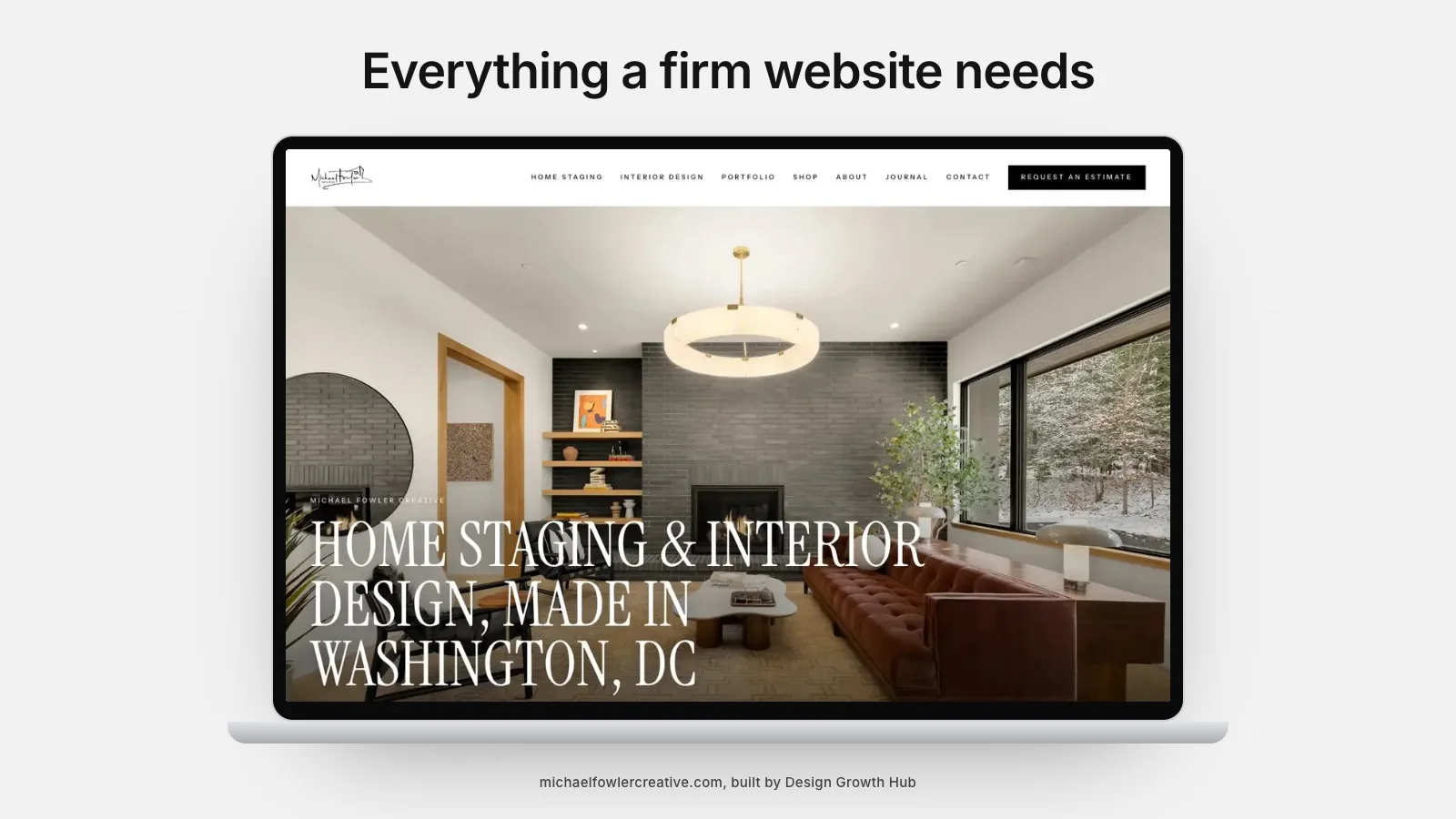
An interior design company website should include a clear home page, individual service pages, a portfolio with a page for each project, an about page that introduces the team and process, real proof such as press and testimonials, accurate business details and an easy way to inquire. Firms with several designers or disciplines also need to show the depth of the team and how projects are managed.
Use the checklist below to review your own site, page by page.
Home page
- A plain statement of what the company does, for whom and where.
- A strong opening image of representative work.
- A selection of featured projects linking to full project pages.
- A short summary of services linking to each service page.
- A line or two about the team and approach.
- Proof: press logos, awards, a testimonial.
- One consistent invitation to inquire.
Service pages
A design company usually offers several distinct services: full-service residential design, renovation, new construction collaboration, commercial or hospitality work, furnishings and styling. Each should have its own page explaining who it suits, what it includes, how the process works and examples of related projects.
Service pages are where many companies leave visibility on the table. They match what people search for and give Google specific pages to show. Our article on why studios need service pages explains why.
Portfolio and project pages
- A portfolio overview, filterable by project type or location once it is large.
- A page for each significant project with an introduction, project facts, story and gallery.
- Captions that name rooms, materials and collaborators.
- Notes on publications and awards where relevant.
Our guide to building an interior design portfolio website covers structure in more depth.
About, team and process
Clients hiring a company want to know who will actually work on their home. Introduce the principals and key team members with real photos and short, specific bios. Explain how the firm is organized and how projects are managed, from first meeting to installation.
A process section reassures clients that a larger project will be handled calmly. It does not need to be elaborate. A few clear stages with a sentence or two each is enough.
Proof and credibility
- Press features and publications, ideally linked.
- Awards and showhouse participation.
- Professional memberships and credentials that genuinely apply.
- Client testimonials in their own words.
- Links to Google reviews.
- Credits to architects, builders and makers you work with.
E+E Design Co. in Denver is a good example of proof presented well. The site includes project stories such as the 2025 Colorado Designer Showhouse, a press section and professional memberships, all integrated calmly. You can see it in the E+E Design Co. case study.
Business details
Your website should state your business name, service areas, contact details and, where relevant, your studio address, written identically to your Google Business Profile and other listings. This consistency helps search engines and AI tools connect all the information about your company. Our article on what Google needs to understand about your studio explains why.
Contact and inquiry
- A short contact form with a clear explanation of what happens next.
- An email address for those who prefer it.
- Service areas and, if appropriate, a studio address or map.
- A friendly confirmation message after submission.
Optional pages that add value
- Location pages for the main areas you serve.
- A journal with articles answering real client questions.
- A shop if you sell furniture, objects or your own products.
- Careers if you are hiring, which also signals growth.
- A trade page if you work with architects or builders.
Not every company needs all of these. Choose the ones that support your goals. Our article on selling products on an interior design website helps with the shop question.
Behind the scenes
Some of the most important parts of a company website are invisible:
- A unique title and description for every page.
- Logical headings and clean page addresses.
- Structured data describing the company, services and projects.
- Fast loading, especially on phones.
- Analytics and Google Search Console connected.
- A privacy policy and accessibility basics in place.
Common gaps we see on company websites
When we review design company websites, the same gaps appear again and again. The team page lists names but not roles, so clients cannot tell who leads projects. Services are described in one paragraph, so a client looking for new construction support cannot find a page about it. Projects show photographs but no location or scope. Press is mentioned on the home page but never linked. The contact form asks for a phone number and a budget before saying anything about what happens next.
Each of these is small and fixable. Together they make a capable firm look less established than it is, which matters most when clients are comparing two or three companies before deciding who to call.
Using the checklist
Go through each section above and mark what your site already does well, what is missing and what needs improving. Most companies find the gaps are in service pages, project stories and business details rather than visual design. Fixing those often brings more improvement than a full redesign.
When a rebuild does make sense, our website creation service covers every part of this checklist. Our guide to what website design services should include explains what to expect from any provider, and our step-by-step guide to creating an interior design website sets out the order of work. If you would like help reviewing your current site, request a studio review.
Strengthen your Google + AI visibility
The studios that get found are not always the best. They are the clearest. Let us make yours easier to understand and recommend.
Request a Studio Review