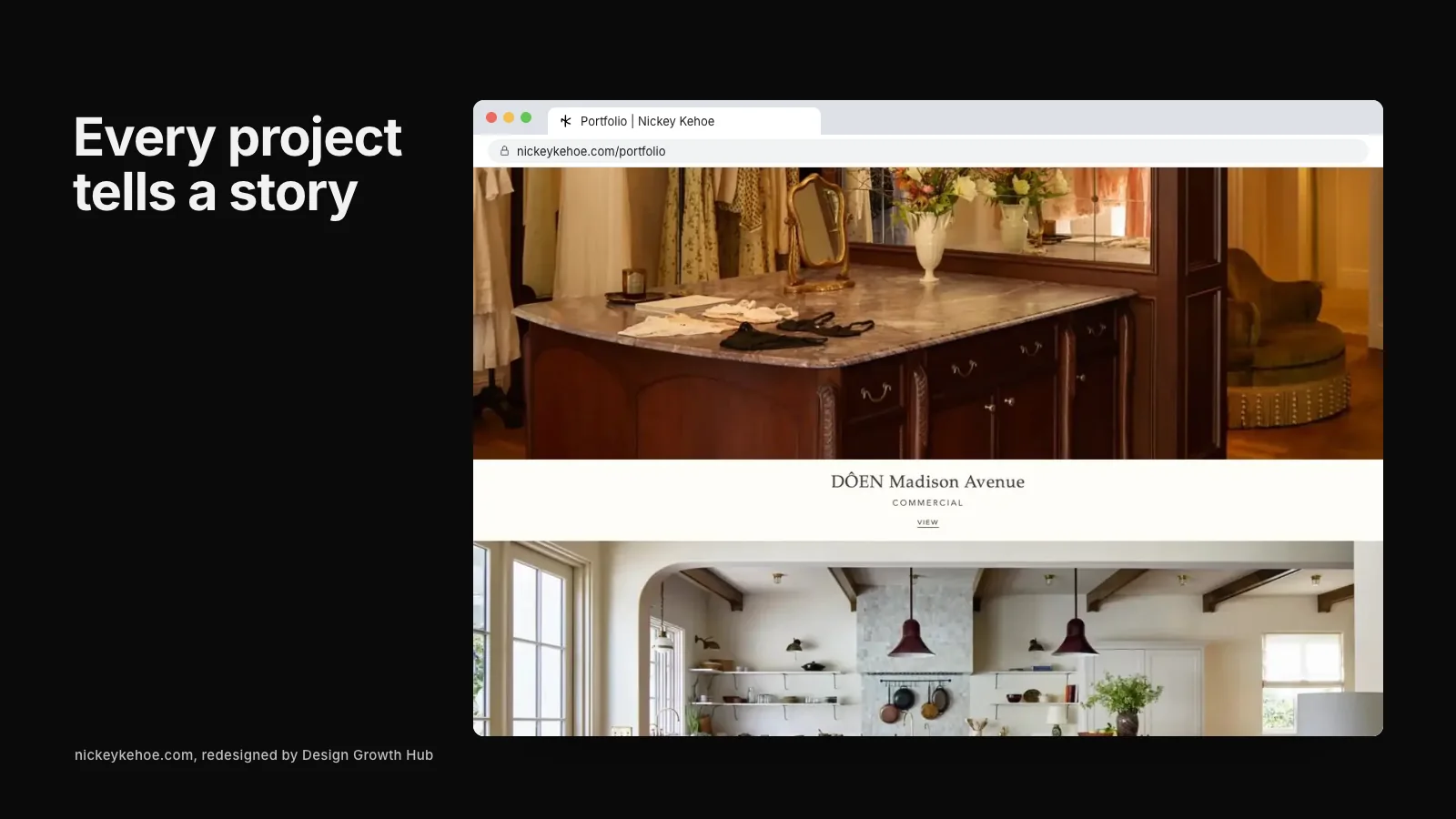
An interior design portfolio website works best when each project has its own page with strong photography and a short written story explaining the brief, the challenge and what changed. A single long gallery may look beautiful, but it leaves prospective clients and search engines guessing about what you actually did.
This guide covers how to choose the projects, how to structure each page and how much to write, so your portfolio becomes the most persuasive part of your website.
Choose the projects that attract the clients you want
Your portfolio is not an archive. It is a selection designed to attract the next client. Start by listing the projects you would happily repeat, then choose six to twelve that best represent that work. Leave out projects that no longer reflect your style, budget range or the services you want to offer.
If you have a large body of work, you can keep an archive section, but put your strongest, most representative projects first. Visitors judge quickly, and the first three projects set expectations for everything else.
Give every project its own page
A dedicated page for each project lets you tell a complete story, show a full gallery and give the work a clear title that search engines can understand. It also lets you link to the project from relevant service pages and articles, which is good for both visitors and visibility.
A strong project page usually includes:
- A descriptive title, such as "Lakefront whole-home renovation in Lake Forest".
- A short introduction describing the client's goal in their terms.
- Key facts: location, project type, scope, size and collaborators.
- A story of two to four paragraphs about the challenge and your approach.
- A gallery paced like a magazine feature, with wide shots and details.
- Captions naming rooms, materials and makers where relevant.
- A link to related projects and a calm invitation to inquire.
Our article on why portfolio pages need more than photos explains each element in more depth.
Write just enough, in your own voice
Designers often worry that writing will clutter their portfolio. In practice, a few well-chosen paragraphs make the photography more meaningful. Explain what the clients needed, what made the project interesting and what you are proud of. Mention constraints honestly: an awkward floor plan, a historic house, a tight timeline. Clients planning similar projects want to know you have handled them before.
Write the way you would speak to a client in a first meeting. Avoid vague adjectives and generic design language. Specific details are more persuasive and far more memorable. For more on this, see our guide to writing project descriptions that AI tools can recommend.
Organize the portfolio the way clients search
Most people do not browse a portfolio in order. They look for work like theirs. Grouping projects by type, such as whole-home renovations, new construction, kitchens and baths or vacation homes, helps them find it. Filters work well once you have more than a dozen projects. For smaller portfolios, a short line under each project thumbnail naming the type and location does the same job.
Location matters too. If you work across several towns or regions, naming them on project pages helps local clients see that you work near them, and it supports your location pages if you have them.
Photography makes or breaks the site
Professional photography is the single most important investment in a portfolio website. Look for consistency: similar light, similar color treatment and a mix of wide, medium and detail shots. If some projects were photographed on a phone, consider leaving them out or reshooting the best ones.
On the technical side, images should be sized and compressed for the web so pages load quickly, especially on phones. Each image should have a short, descriptive file name and alt text that describes the room. Our guide to interior design website images covers sizing and naming.
Build trust around the work
Portfolio pages are a natural place to add quiet proof. A short quote from the homeowner, a note if the project was published or a credit to the architect or builder all reinforce your credibility. Our article on building trust before a client ever contacts you covers more ways to do this without sounding promotional.
Choose a platform that fits your portfolio
Builders such as Squarespace and Showit can host a good portfolio, especially when you are starting out. As your archive grows, or when you want more control over structure, speed and project page layouts, a custom build often becomes worthwhile. Our step-by-step guide to creating an interior design website covers the decision, and building an interior design website with AI tools looks at the newest options honestly.
Lead naturally to an inquiry
At the end of each project, invite the visitor to take the next step. Something simple, like "Planning a renovation like this? Tell us about your home," linked to your contact page, feels natural after a good story. If you run campaigns to specific project types, a focused landing page can do the same job for paid traffic.
Lisa Furey Interiors is a good example of this structure in practice: ten project stories, a press archive and calm invitations to inquire. You can see it in the Lisa Furey Interiors case study.
If your portfolio looks beautiful but brings few inquiries, our website creation team can help you restructure it. Or request a studio review and we will look at your current portfolio first.
Turn your website into a visibility asset
A website can be a brochure or an asset that brings clients. We help design studios build the second kind.
Request a Studio Review