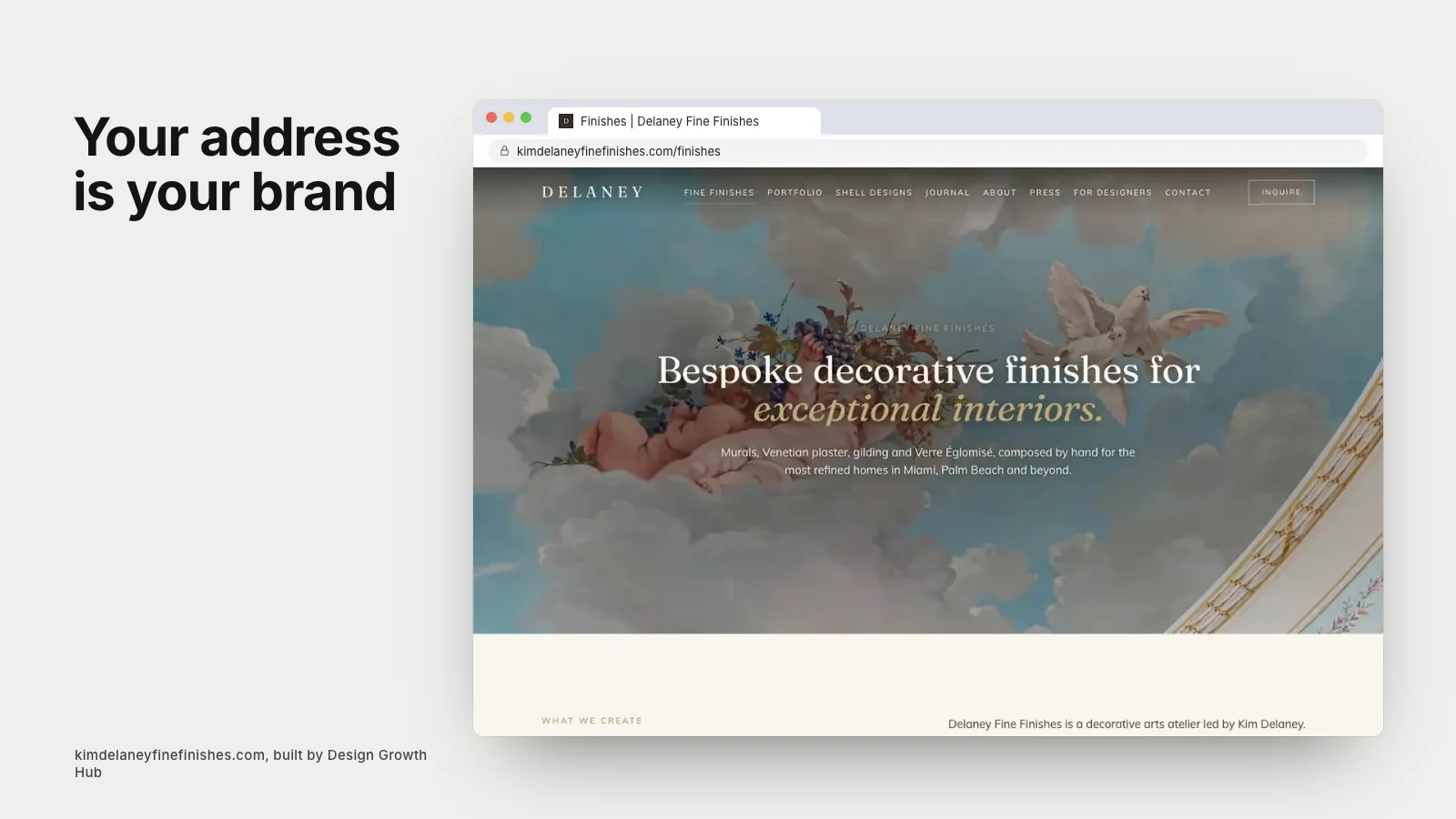
For an interior design website, your own domain, registered in your name, is almost always worth the small annual cost. Free subdomains that include a platform's name look less professional and tie you to that platform. Free first-year domain offers from website builders can be fine, as long as the domain is registered to you and you can transfer it later. What matters is that you own and control your address.
Here is how to choose a good domain, where to register it and how to avoid the mistakes that cause problems years later.
Free subdomain versus your own domain
There are two different things people mean by a free domain.
- A free subdomain: an address like yourstudio.wixsite.com or yourstudio.squarespace.com, provided by the platform. It costs nothing but includes the platform's name.
- A free first-year domain: many builders include a real domain, such as yourstudio.com, free for the first year when you buy an annual plan. After that, you pay a renewal fee.
The first is rarely suitable for a professional studio. The second can be perfectly good, with a few precautions.
Why owning your domain matters
Your domain appears on business cards, Instagram bios, email signatures, Google Business Profile, press features and directory listings. Over time, other websites link to it. That history builds trust with both people and search engines.
If the domain is registered in someone else's name, such as a former web designer or a platform account you no longer control, you can lose access to all of that. Owning it means you can move your website to any platform, change providers and keep your address.
Choosing a good domain name
A good domain for a design studio is:
- Short and easy to say aloud, so clients can remember it after a conversation.
- Close to your studio name, so people can guess it.
- Easy to spell, avoiding unusual spellings and double letters where possible.
- Free of hyphens and numbers, which are easy to mistype.
- A .com where possible, since many people type .com by default.
If your exact name is taken, try adding a word such as "design", "interiors" or "studio", or your city. For example, annareedinteriors.com or reedstudiodesign.com.
Should my domain include keywords?
Including words like "interiors" or your city can help clarity, but exact keyword domains, such as bestinteriordesignerchicago.com, look less trustworthy and do not bring a meaningful search advantage. Choose a domain that reflects your brand, then let your content and Google Business Profile do the work. Our guide to SEO for interior designers explains what actually helps visibility.
Where to register
You can register a domain directly through your website builder or through a separate registrar. Both work. Registering separately keeps your domain independent of your website platform, which can make future changes simpler. Wherever you register, make sure:
- The domain is in your name or your business's name.
- You have the login details and they are stored safely.
- Auto-renewal is turned on with a current payment method.
- Your contact email on the registration is one you check.
Free first-year offers: what to check
If you accept a free domain with a builder plan, confirm the renewal price, check that you can transfer the domain away later and note when the free period ends. Some offers renew at a higher price than registering independently, which is fine as long as you know.
Use your domain for email
A professional email address on your own domain, such as hello@yourstudio.com, looks far more established than a free email account. Email hosting is inexpensive and usually simple to set up through Google Workspace, Microsoft 365 or your builder.
Protect your domain
Lost domains are a surprisingly common problem. They happen when a card expires, an email address changes or a former designer registered the domain in their own account. Protect yours by:
- Keeping auto-renewal on and payment details current.
- Registering for several years at a time if you like.
- Turning on domain privacy and registrar lock if offered.
- Keeping a simple record of where your domain is registered.
Changing domains later
If you already use a domain that no longer fits, perhaps after a rebrand, you can move to a new one. The key is to redirect every old page address to its equivalent on the new domain, update your Google Business Profile and listings and tell Google Search Console about the move. Martire Custom Homes moved to a new domain as part of a new brand identity and website, which you can see in the Martire Custom Homes case study.
Where the domain fits in the bigger picture
Your domain is the foundation. The website built on it still needs strong content and structure. Our guides to creating an interior design website step by step, what an interior design company website should include and building a portfolio website cover what comes next. If you are deciding between free and paid platforms more broadly, see whether a free interior design website is good enough.
Our website creation service handles domains, email setup and redirects as part of every build. If you are unsure who controls your current domain, request a studio review and we will help you check.
Strengthen your Google + AI visibility
The studios that get found are not always the best. They are the clearest. Let us make yours easier to understand and recommend.
Request a Studio Review