The construction company websites worth learning from share a few qualities: they lead with real projects, explain their process clearly, introduce the people behind the work, show credentials and reviews and make it easy for the right clients to get in touch. Different types of companies emphasize these elements differently. Below are patterns from strong sites, including one we built, along with what you can borrow for your own.
The luxury renovation and custom home builder
Builders working on high-end homes need websites that feel as considered as the homes themselves. The strongest sites lead with full-width photography, tell each home's story and explain a calm, organized process. Press, awards and design partners appear quietly.
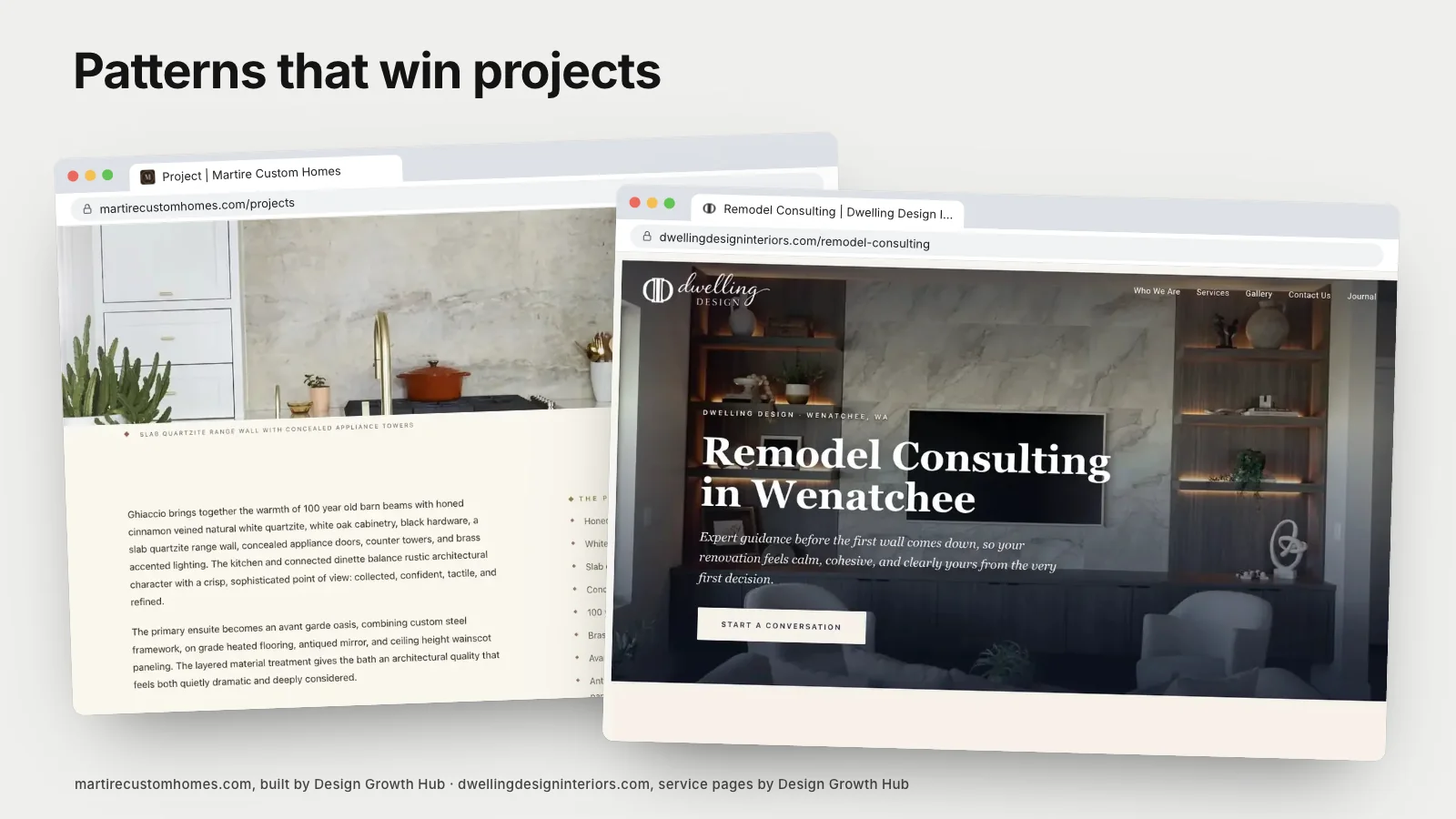
Martire Custom Homes, a renovation and custom home builder near Chicago, is an example from our own work. The project began with a new monogram and logo suite, followed by a 49-page website on a new domain with portfolio stories, press, process, a journal and service-area pages for Chicago and the North Shore. You can see how it came together in the Martire Custom Homes case study.
What to borrow: tell each project as a story and give your process its own page.
The craftsman builder
Some builders are known for craftsmanship: timber framing, fine millwork, restoration. Their best websites show details up close, explain techniques and introduce the craftspeople. The tone is personal and proud of the work.
What to borrow: photograph details, not just finished rooms, and explain what makes your work distinctive in plain language.
The design-build firm
Design-build firms offer design and construction under one roof. Strong sites explain the benefits of that model clearly, show the design process alongside construction and present the team of designers and builders together.
What to borrow: if you offer more than construction, explain how the parts fit together and why it benefits clients.
The commercial contractor
Commercial contractors serve developers, businesses and institutions. Their strongest websites organize projects by sector, provide project data such as size and schedule, highlight safety and certifications and make it easy for prospective clients and subcontractors to find relevant information.
What to borrow: organize projects so visitors can find work like theirs quickly, and include the facts decision makers need.
The local remodeler
Local remodelers serving homeowners need websites that build trust fast. The best ones show before and after projects, display reviews prominently, list service areas clearly and make requesting an estimate simple on a phone.
What to borrow: put reviews and real projects close to the top and make contact effortless.
Patterns across every strong example
- A clear opening line saying what the company builds and where.
- Real project photography, organized by type.
- Project stories or facts, not just galleries.
- A process page that explains how projects run.
- A team page with real photos.
- Credentials and reviews, easy to find.
- Service areas clearly listed.
- Simple contact paths for different audiences.
These patterns appear because they answer the questions clients ask before choosing a builder.
The design-build remodeler
Between the local remodeler and the design-build firm sits a common type of company: a remodeler with an in-house designer who handles kitchens, baths and additions from concept through completion. The strongest sites for these companies show design drawings or renderings alongside finished photos, explain how design and construction are coordinated and introduce both the designer and the production team. Homeowners appreciate seeing that someone will guide them through selections as well as build the work.
What to borrow: if you offer design help, show it. Process images and a short explanation of how selections work can set you apart from contractors who only build.
The family-owned builder
Many construction companies are family businesses with decades of local history. Their best websites lean into that story with photos across generations, long-standing client relationships and a sense of accountability that comes from a family name on the sign. The history is presented briefly and warmly, then linked to recent projects so the company feels established and current at the same time.
What to borrow: if you have history, tell it briefly and connect it to how you work today.
Mistakes the best examples avoid
They avoid stock photography, vague slogans, outdated project galleries, hidden contact information and slow, heavy pages. They also avoid trying to speak to every audience on the same page. Clear paths for homeowners, commercial clients, partners and job seekers keep each visitor focused.
How to use examples well
When you look at another company's website, note what makes it clear and trustworthy rather than copying its look. Ask how quickly you understand what the company does, how easy it is to find relevant projects and how the site makes you feel about working with them. Then apply those lessons to your own content and brand.
Planning your own site
Our guides to construction company website design essentials and what content a construction company website needs explain how to plan your pages. For the portfolio specifically, see building a construction company portfolio website. When you are ready to budget and build, our articles on construction business website cost, how to build a construction business website and hiring a contractor website design company cover the practical steps.
If you would like a website that applies these patterns to your company, our website redesign service works with builders and contractors. You can also browse our case studies, or request a studio review to talk about your site.
Make your studio easier to find
When the right clients search, clarity is what brings them to you. Let us look at the structure behind how you are found.
Request a Studio Review