Interior design SEO services should include an audit of your website and Google presence, research into how clients search for your services, improvements to service, project and location pages, technical fixes, Google Business Profile optimization, a review strategy and regular, plain reporting. Increasingly, they should also cover how AI tools understand and describe your studio. Honest providers explain what they will do, how long it typically takes to see progress and what they cannot promise.
Here is what each part involves, so you can judge proposals with confidence.
The audit
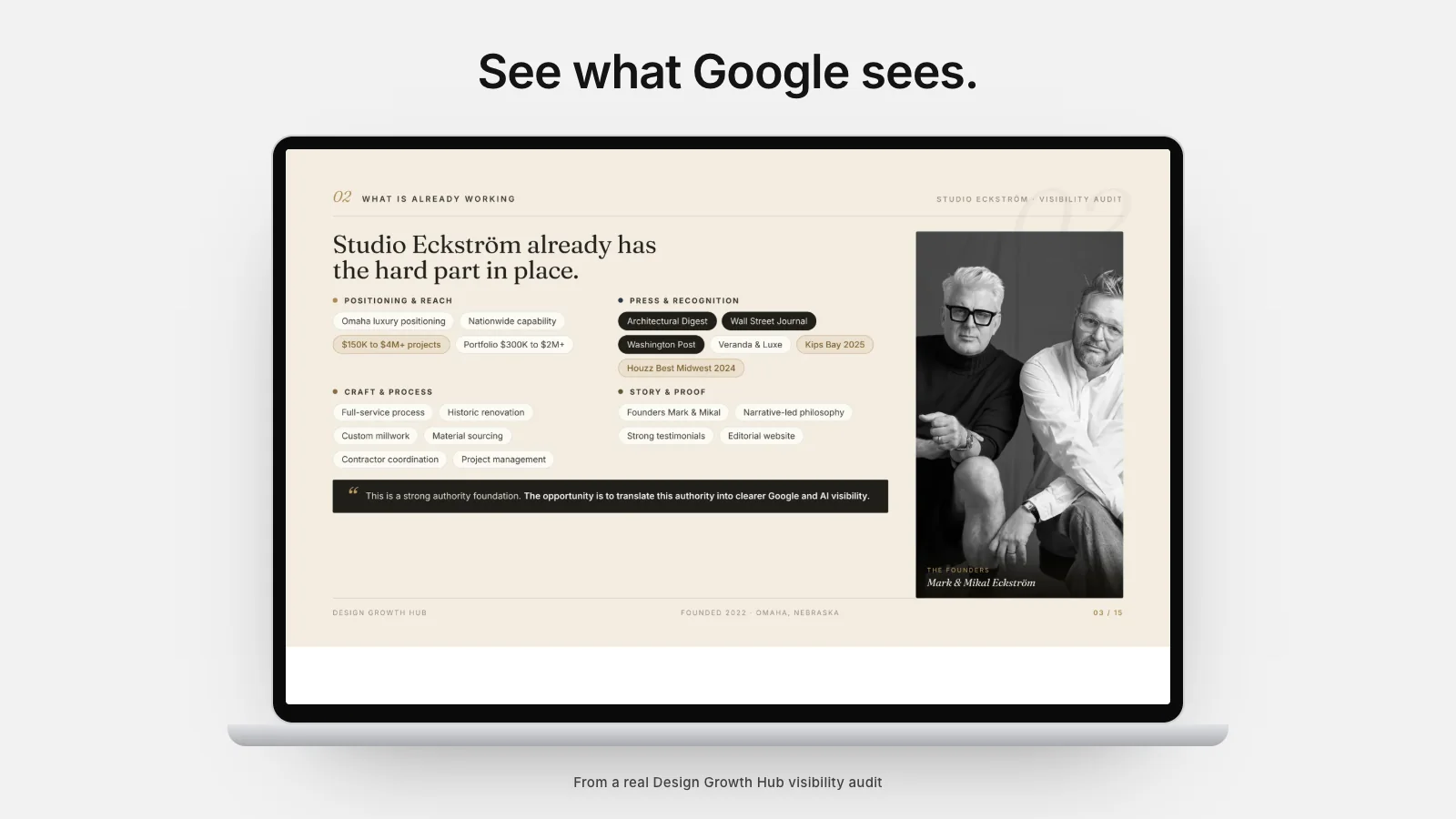
Every good SEO engagement starts with an audit. That means a review of your website's structure, content, speed, mobile experience and technical health, along with your Google Business Profile, reviews and how consistently your studio is described across the web. It should end with a prioritized list of problems and opportunities, written in language you can understand.
If a provider skips the audit and jumps to a monthly package, ask how they know what your site needs. Our article on what a Google and AI visibility audit covers explains the process.
Search research
Next comes understanding how your clients search. For interior designers, that usually includes searches by service ("full-service interior design"), by project type ("kitchen renovation designer") and by place ("interior designer in Greenwich"). Good research focuses on searches that reflect real client intent, not just high volumes.
Our article on why high-value clients search by project type explains why project type matters so much, and ranking for full-service interior design searches looks at one of the most valuable categories.
Website improvements
Most SEO progress for design studios comes from improving the website itself:
- Creating or improving a page for each core service.
- Adding location pages for the main areas you serve, where they make sense.
- Expanding project pages with stories, facts and captions.
- Writing clear page titles, descriptions and headings.
- Improving internal links between projects, services and articles.
- Adding structured data that describes your business and work.
Some providers do this work directly. Others hand you recommendations. Clarify which. If your site needs a rebuild first, our guide to what website design services include explains how the two kinds of work fit together.
Technical fixes
Technical SEO covers the behind-the-scenes health of your site: speed, mobile usability, indexing, broken links, redirects, duplicate pages and sitemap files. For many design studios, image-heavy pages are the biggest technical issue. A good provider fixes these or works with your developer to do so.
Google Business Profile
For local visibility, your Google Business Profile matters as much as your website. SEO services should include completing and optimizing it: categories, services, description, photos, service areas and regular updates. Our guide to Google Business Profile for interior designers covers what a strong profile looks like.
Reviews and reputation
Reviews affect both trust and local visibility. A good provider helps you build a simple, consistent process for requesting reviews from happy clients and responding to them. They should never suggest fake reviews or incentives that break Google's guidelines.
Content
Some engagements include articles or guides that answer real client questions. Content is valuable when it is genuinely useful and connected to your services. It is not valuable when it is generic text produced at volume. Ask to see examples of content the provider has written for other studios.
AI search visibility
More clients now ask ChatGPT, Gemini, Perplexity and Google's AI Overviews to recommend designers. These tools rely on clear, consistent information across your website, Google profile, reviews and press. SEO services that understand this will make sure your studio is described accurately everywhere. Our article on entity-based visibility explains the idea, and the 90-day visibility foundation sets out a practical starting plan.
Reporting
You should receive regular reports that explain what was done, what changed and what comes next. Useful reports focus on meaningful measures: visibility for important searches, website visits from search, Google profile actions, inquiries and, where possible, their quality. Be wary of reports full of charts with no explanation.
Red flags
- Promised rankings: no one can promise a specific position on Google.
- Secret methods: reputable providers explain what they do.
- Long contracts with vague deliverables: you should know what you are paying for.
- Buying links or fake reviews: these risk penalties and damage trust.
- Generic content at volume: thin articles rarely help design studios.
Our guide to choosing an SEO company for interior designers covers selection in more depth.
How long SEO takes
SEO is gradual. Some improvements, such as fixing a Google profile or adding missing service pages, can show results within weeks. Broader visibility usually builds over months. Anyone promising instant results is either overpromising or using risky shortcuts.
Our approach
At Design Growth Hub, our Google search services are built for design studios, architects and builders, covering the website, Google Business Profile and AI visibility together. If you would like to see what your studio needs first, request a studio review. You may also find our checklist of what a company website should include helpful as a starting point.
Request a Studio Review
If your work is already strong, the next step is making sure Google + AI can understand it clearly.
Request a Studio Review