On this page5 sections
A homeowner planning a whole-home remodel rarely types your studio name into Google. They type something closer to what they actually need: "full-service interior design near me," or "interior designer who handles everything from layout to furnishing." That phrase carries a specific expectation. They want one team accountable from the floor plan to the final styled shelf, and they are quietly filtering out anyone who looks like they only do mood boards.
If your work covers that full arc but your website does not say so in language Google and AI tools can read, a smaller competitor with clearer pages can sit above you. Closing that gap is the heart of luxury interior designer SEO, and it starts with understanding what "full-service" really signals to a search engine and a buyer.
"Full-service" is a scope filter, not a buzzword
When a client searches for full-service interior design, they are screening for capability and accountability. They have likely been burned, or heard a story, about a designer who delivered beautiful renderings and then disappeared at the contractor stage. So the query is really a question: can one studio carry this from concept through procurement, installation, and styling without me project-managing the gaps?
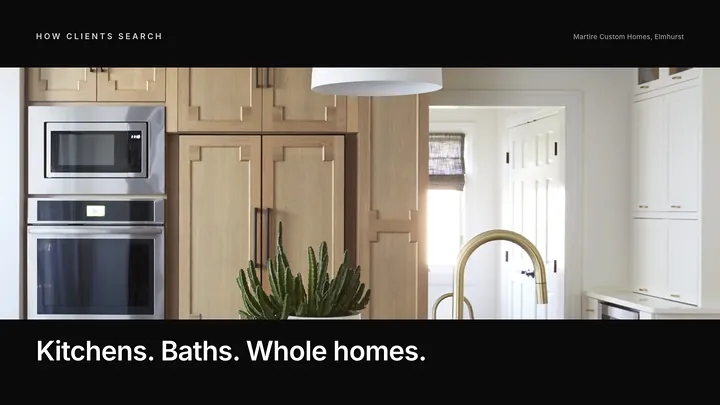
Google and AI systems read your pages the same way a careful client does. If your site only shows finished photos, the safest assumption a machine can make is that you are a stylist or a decorator. That is why so many capable firms get mislabeled. The fix is not louder adjectives. It is naming the scope plainly, which is also why high-value clients search by project type rather than studio name. Clients search by project type, not studio name
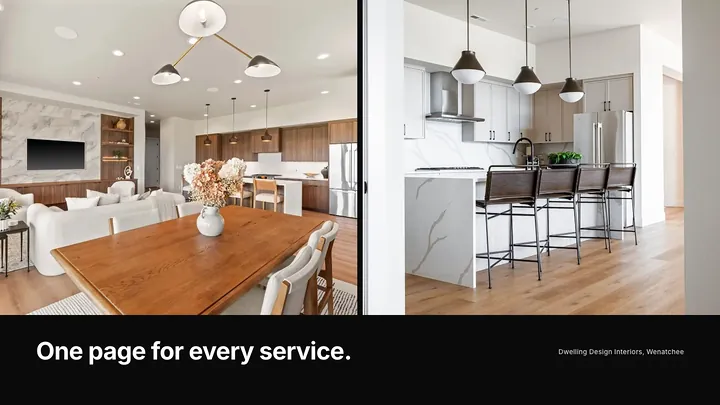
Give full-service its own service page
A portfolio shows that you can do the work. A service page tells Google and AI what the work is, who it is for, and how it runs. Those are different jobs, and your portfolio cannot do both. This is the core reason interior designers need service pages, not just a portfolio.
A strong full-service page makes the entire engagement legible. It should answer the questions a serious client and a search engine both have:
- The phases you own: space planning, design development, procurement, project oversight, install, and styling.
- The project types you take on, like whole-home remodels, new construction, or luxury residential builds.
- How you coordinate with builders and architects on design-build and custom homes.
- What "full-service" excludes, so the wrong-fit inquiry self-selects out.
That clarity does double duty. It qualifies the lead before they ever email, and it gives AI tools the structured facts they need before they will name you. Project descriptions help AI recommend your studio
Match the page to how machines understand your studio
Ranking for a scope query is not about repeating the phrase "full-service" twenty times. It is about coherence. Google and AI assistants build a model of who you are from everything they can read: your service pages, your project descriptions, your About page, your reviews, and the way it all connects. Google needs to understand your studio before it recommends you, and AI tools have their own checklist before they will recommend you. What AI tools need to know before they recommend an interior designer
The studio that gets recommended is rarely the one with the prettiest homepage. It is the one whose pages agree with each other about what it does, for whom, and where.
Practical structure carries a lot of this weight. Clear page slugs, accurate metadata, and internal links that tie your full-service page to your relevant projects all help a machine confirm the scope you claim. Internal linking helps Google understand your studio, and structured markup makes the relationships explicit. Schema helps Google and AI understand interior designers
Let your projects prove the full arc
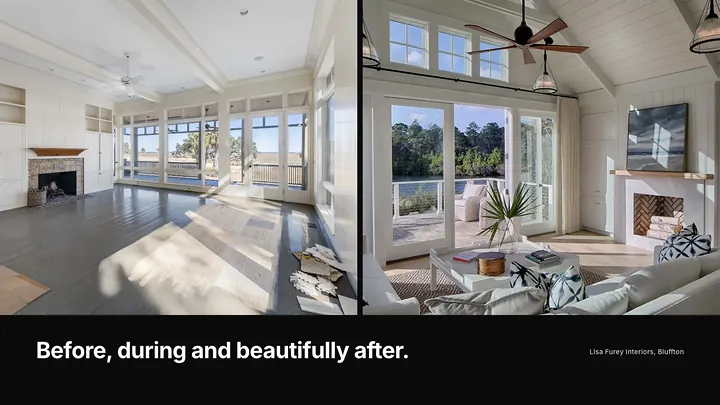
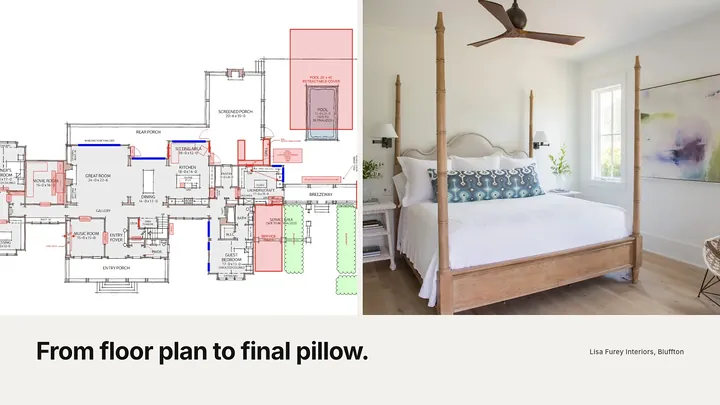
A full-service claim is only believable if the work behind it shows the full arc. A portfolio entry that is three glamour shots and a city name does not demonstrate that you handled the kitchen and bath gut, the lighting plan, the custom millwork, and the final furnishing. Project pages that narrate the scope do.
Write each project so the reader, and the AI summarizing it, can see what you actually owned: the starting condition, the decisions you made, the trades you coordinated, and the outcome. That is the difference between a gallery and proof. Portfolio pages need more than pretty photos, and the right write-up also lets your case studies do the persuading. Case studies help interior designers win better clients
Pair scope clarity with local and trust signals
Full-service projects are high-commitment and usually local. A client handing you a whole-home remodel or a lakeside custom build wants to know you are real, reachable, and reviewed. So scope clarity needs to sit on a foundation of local authority. A complete Google Business Profile and genuine reviews tell both buyers and search engines that you are an established studio, not a portfolio with no address.
From complete structuring to visibility. The work moves in order: name the scope, prove it with projects, support it with structure, then reinforce it with local trust so you show up when someone nearby searches for exactly what you do. The visibility foundation every studio needs ties these layers together, and reviews quietly carry more weight than most designers expect. Reviews help interior designers appear more trustworthy online
Next step
Make your studio easier to find
When the right clients search, clarity is what brings them to you. Let us look at the structure behind how you are found.
Request a Studio Review
Website redesign, Google SEO, Google Business Profile and AI search visibility, trusted by more than 100 interior design studios, architects and contractors across the United States.
 ChatGPT
 Gemini
 Perplexity
 Claude
 Copilot