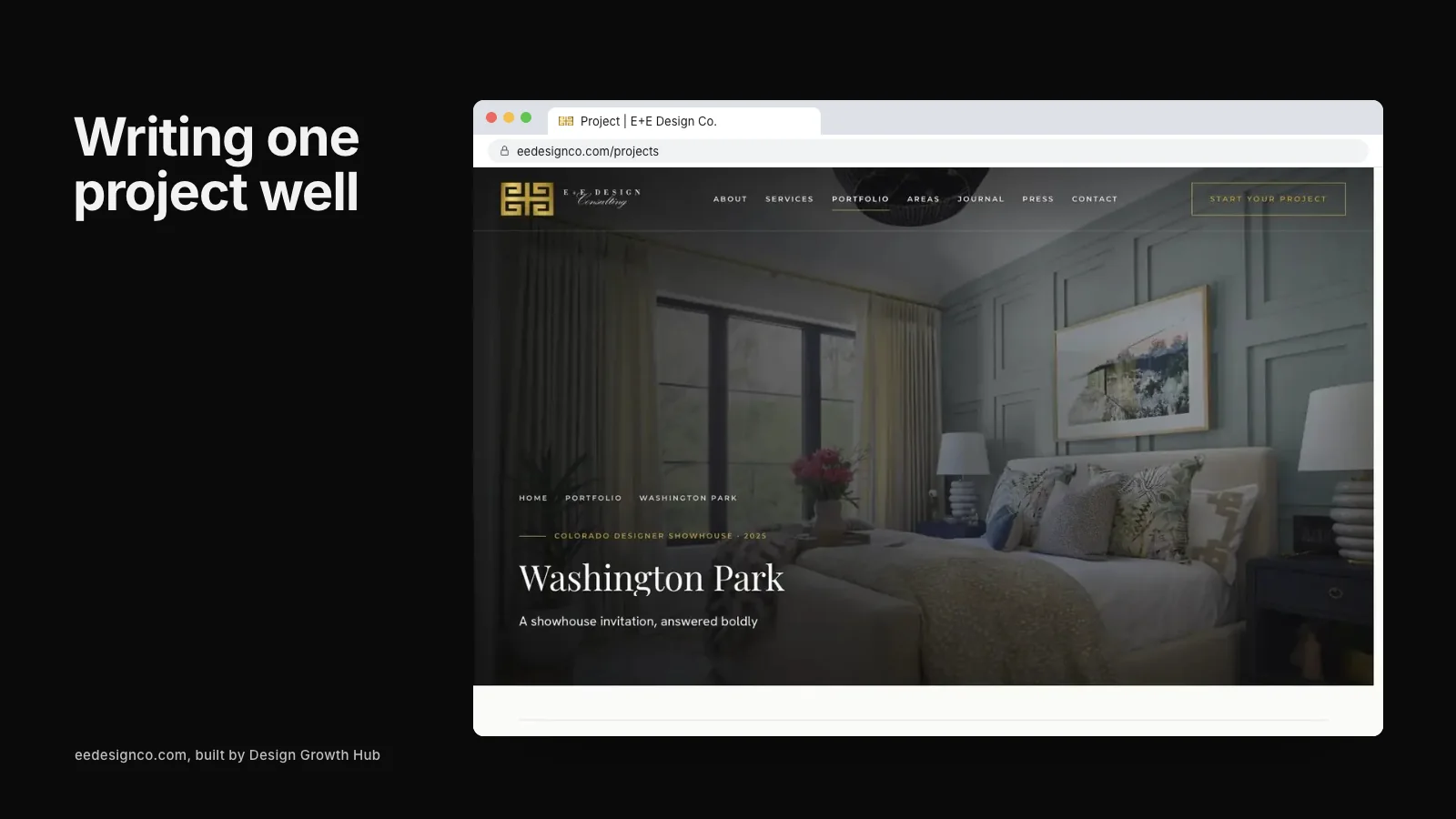
An interior design project portfolio page should include a descriptive title, a short introduction, a set of project facts, a story of a few paragraphs about the brief and the result, a paced gallery with captions, credits and a closing invitation. Writing one well takes an hour or two, and it turns a set of photographs into evidence that clients and search engines can understand.
Below is a structure you can follow, with prompts for each section and an example to adapt.
Start with a descriptive title
A project title should tell people what the project is. Evocative names like "Serenity" or "The Wren" can work as a secondary name, but the main title should be descriptive: "Whole-home renovation of a 1920s Tudor in Evanston" or "New construction lake house in Harbor Springs".
Descriptive titles help visitors scanning your portfolio and match how clients search. Our article on why high-value clients search by project type explains why this matters.
Write a short introduction
Two or three sentences that set the scene. Who were the clients, what did they need and what was the starting point? Keep it human and specific.
Prompt: "The clients came to us wanting..." or "When we first saw this house, ..."
Add the project facts
A short block of facts makes the page easy to scan:
- Location
- Project type, such as renovation, new build or furnishing
- Scope, such as full-service interiors, kitchen and baths
- Size or number of rooms, if helpful
- Architect, builder and other collaborators
- Photographer
- Publications, if any
These facts are useful for clients and particularly valuable for search engines and AI tools, which rely on clear, structured information.
Tell the story in three or four paragraphs
This is the heart of the page. Cover the brief, the challenges, the key decisions and how the home feels now. Mention anything distinctive: a historic detail you preserved, a difficult floor plan you resolved, a material you sourced, a maker you worked with.
Prompts:
- What was the biggest challenge, and how did you solve it?
- Which room or detail are you proudest of, and why?
- What did the clients say when they saw the finished home?
- What would someone planning a similar project want to know?
Write as you would speak to a prospective client. Specific details persuade far more than adjectives like "stunning" or "timeless".
Pace the gallery
Open with a strong establishing image. Move through the main spaces, then pause on details. Pair related images. Keep the selection tight, usually twelve to twenty images for a full project. Our guide to interior design portfolio examples shows several pacing approaches.
Write captions that add meaning
Captions should say something the photo cannot. Name the room and a key material, maker or decision:
- "Living room with a reclaimed limestone fireplace surround."
- "Custom walnut cabinetry by a local workshop."
- "Primary bedroom, where we lowered the ceiling to create intimacy."
Captions are optional on every image but valuable on the most important ones.
Credit collaborators
Credit the architect, builder, landscape designer, photographer and stylist where appropriate. It is courteous, it strengthens professional relationships and it adds credibility. If the project was published, link to the feature.
Close with an invitation
End with a sentence linking to your contact page, framed around the visitor's own plans: "Planning a renovation like this one? Tell us about your home." Add links to two or three related projects.
An example to adapt
Title: Whole-home renovation of a 1920s Tudor in Evanston
Introduction: A young family loved the character of their Tudor but found it dark and closed off. They asked us to open the main floor, add a kitchen that could handle everyday chaos and keep the details that made them fall in love with the house.
Story: We worked with the architect to widen two openings rather than remove walls entirely, keeping the original plaster moldings. The kitchen moved to the back of the house, where morning light falls across a long island in honed marble. Upstairs, we reworked a narrow hall bath into a calm family bathroom with a deep tub and a window seat.
That is all it takes. A few honest, specific paragraphs.
Common mistakes to avoid
- Writing about yourself instead of the clients: keep the focus on their goals and their home.
- Listing every product: a few meaningful details are better than a sourcing list.
- Using the same story for every project: each one should feel distinct.
- Leaving out the location: it matters to local clients and to search.
- Overstating your role: be clear about what you designed and what collaborators delivered.
Read the finished page aloud once. If any sentence sounds like a brochure rather than you, rewrite it in plainer words.
How project pages fit the bigger picture
Each project page should link to the service it represents and to related projects. Together with service pages, they form the structure that helps Google understand your studio. Our articles on why portfolio pages need more than photos and why designers need service pages explain the wider strategy, and showing a residential portfolio online covers presentation for homes specifically. Your home page can then feature your strongest project pages.
If writing project pages feels like a mountain, our website redesign team can help write and structure them with you. Or request a studio review and we will look at a project page you already have.
Build your visibility foundation
Design Growth Hub helps interior designers build the visibility foundation behind high-value discovery.
Request a Studio Review