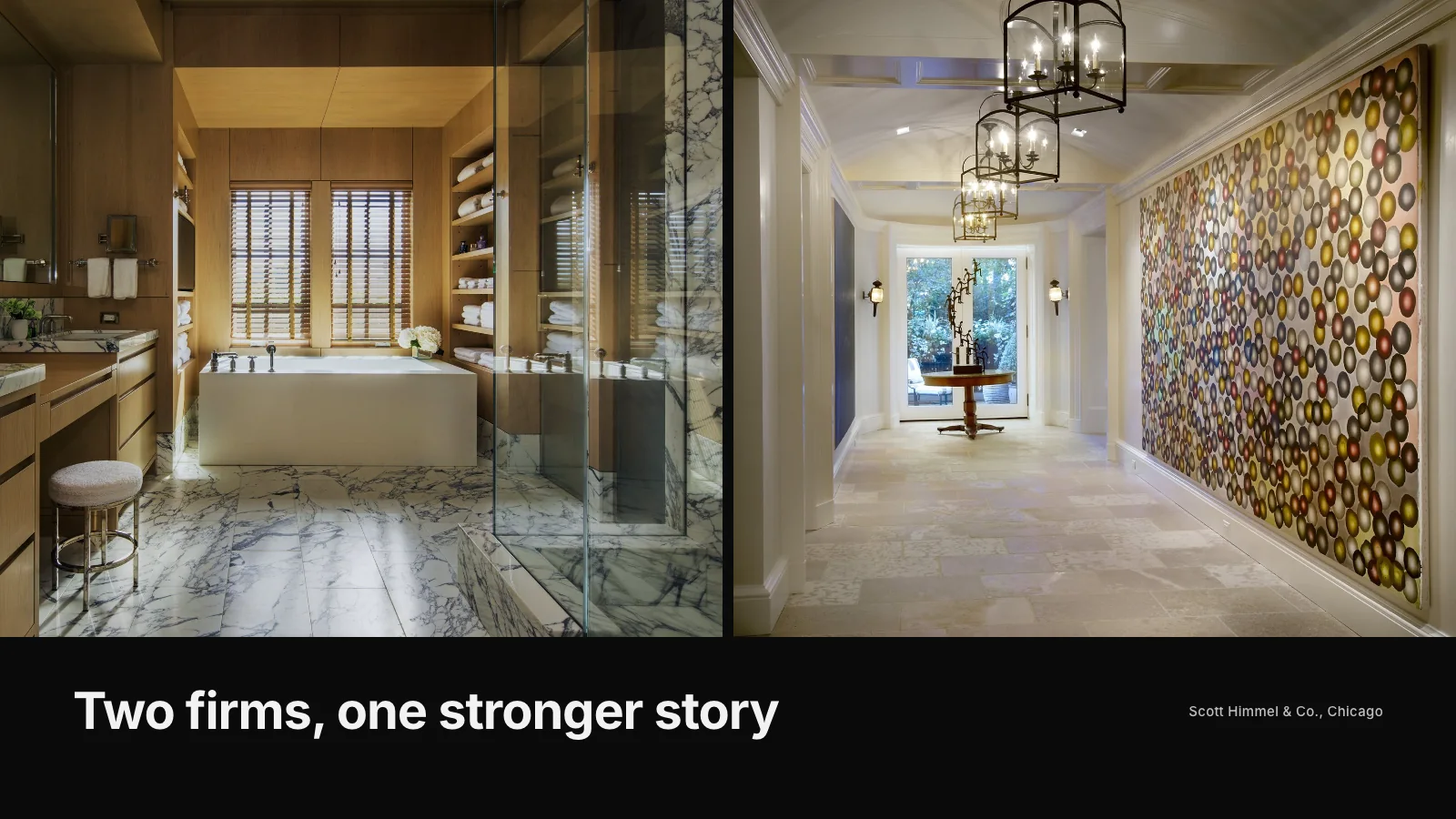
Interior designers and architects who collaborate can strengthen each other's visibility by presenting shared projects thoughtfully: each firm publishing its own project page that describes its role accurately, crediting the other firm by name, linking between the two pages, coordinating photography and press and keeping project names and details consistent. Search engines and AI tools see a network of credible, connected information, and clients see two respected firms who work well together.
Here is how to approach SEO for collaborative work.
Why collaboration helps visibility
When two respected firms present the same project, each with a link to the other, search engines see credible connections between relevant businesses. Clients researching one firm discover the other. Publications covering the project often mention both. Together, these signals strengthen the reputation and visibility of each practice.
Each firm tells its part
On each website, describe the project from your perspective. The architect might focus on the site, structure and plan; the interior designer on the rooms, materials and furnishings. Both should describe their role accurately and avoid implying they did everything. Honest, specific descriptions build trust with clients and partners.
Credit and link
Name the collaborating firm on the project page and link to its website, ideally to its page about the same project. Reciprocal links between relevant project pages help visitors and search engines understand the relationship.
Consistent project naming
Use the same project name and location on both sites, where possible. Consistent naming helps search engines and AI tools connect information about the project and the firms involved.
Coordinate photography
Agree in advance how photography will be shared, credited and used. Each firm may need different images to tell its part of the story. Clear usage agreements prevent misunderstandings and make it easier to publish promptly.
Joint press
Publications often prefer stories that include the full design team. Coordinated press submissions can increase the chance of coverage, and features naming both firms benefit both.
Google Business Profiles
Each firm should maintain its own complete profile with photos of its work. Sharing project photos on each profile, with credit, extends reach.
Content partnerships
Firms can collaborate on content: a joint article about designing a home from plan to finished interiors, a talk at a local design event or a video tour of a completed project. Shared content reaches both audiences.
Strong brands still need structure
Even well-known firms benefit from clear, connected information. Our article on why designers with strong brands still need SEO explains why reputation alone is not enough.
Entity thinking
Search engines and AI tools understand businesses as entities connected to places, services, people and projects. Shared projects create connections between your entities. Our article on entity-based visibility explains the concept.
Local visibility
Collaborations are often local. Shared projects with locations support both firms' local visibility. Our article on local SEO for interior designers explains local foundations that apply to architects as well.
Competitive searches
Searches such as "best interior designer in [city]" or "luxury interior designer" are competitive. Credible collaborations and shared press help. Our articles on best in city searches and ranking for luxury interior designer searches explain the wider approach, and SEO, AIO and GEO explains how search and AI visibility relate.
Practical checklist for each shared project
- Agree on the project name and location to use.
- Agree on photography credits and usage.
- Publish each firm's project page with an accurate role description.
- Link the two pages to each other.
- Coordinate press submissions.
- Share the project on each firm's Google profile and social media with credit.
When one firm offers both disciplines
Some practices offer architecture and interior design under one roof. For them, collaboration happens internally, but the same principles apply: describe how the disciplines worked together on each project, introduce the people from both sides and make it clear what services clients can engage. Our article on one website for an architecture and interior design practice explores this approach in depth.
Shared articles and expertise
Collaborating firms can create content that neither could write alone: how architecture and interiors come together in a renovation, how to coordinate cabinetry with architectural details or how lighting is planned from structure to fixtures. Publishing these articles on both sites, with each firm contributing its perspective and linking to the other, offers clients genuinely useful information and reinforces the relationship.
Reviews that mention collaboration
Clients often appreciate when their architect and designer worked well together. Reviews that mention the collaboration help both firms. You cannot write reviews for clients, but you can mention, when asking, that it is helpful to describe the whole experience.
Building a network
Over time, a group of firms who regularly collaborate, such as an architect, interior designer, landscape architect and builder, can become known together in a region. Featuring each other's work, appearing together at events and sharing press creates a network that clients recognize and trust.
Measuring shared impact
Notice when inquiries mention the collaborating firm or a shared project. These signals show how collaboration supports both practices.
Respect and accuracy
Collaboration works best when both firms feel fairly represented. Share drafts of project descriptions with each other before publishing. Accuracy protects relationships and reputations.
If you would like help presenting collaborative projects for maximum visibility, our Google search services work with interior designers and architects. Or request a studio review to start.
Start with a Google + AI visibility audit
Before changing anything, it helps to see clearly. A visibility audit shows exactly where your studio is easy, or hard, to understand.
Request a Studio Review