On this page6 sections
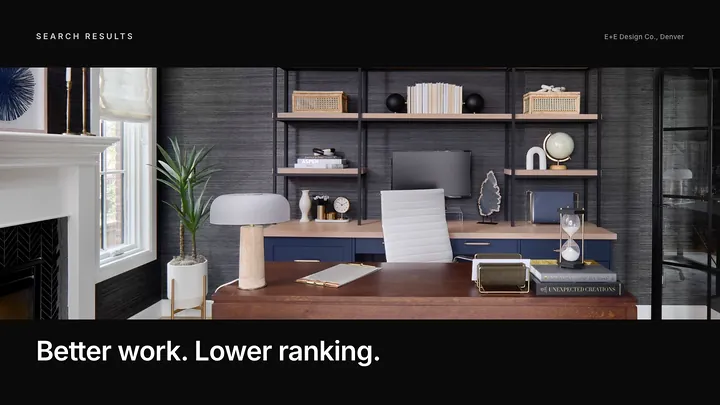
You have seen the firm. Their kitchens feel safe, their styling looks dated, and their photography does not do their projects any favors. Yet when a homeowner in your market searches for a designer, their name appears first and yours does not appear at all. It stings, because you know your work is the stronger of the two.
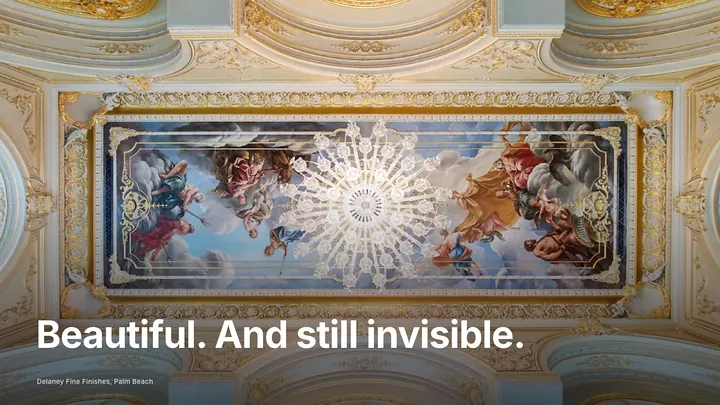
The hard truth is that search does not rank beauty. It ranks clarity. A competitor with weaker projects but a cleaner, more legible online foundation will outrank a more talented studio that Google and AI cannot understand. If you want SEO for interior designers that matches the quality of your portfolio, you have to make your studio readable, not just gorgeous.
Google ranks the studio it understands, not the one it admires
A search engine cannot walk through a finished whole-home remodel and feel the proportions of a room. It reads text, structure, and signals. When your competitor spells out exactly what they do, where they work, and who they serve, Google can confidently match them to a search. When your site shows ten stunning images and three words of copy, there is nothing for the algorithm to hold onto.
This is why beautiful interior design websites still fail to bring high-value clients. The visuals impress humans and confuse machines. A cleaner competitor wins not because they are better, but because they are easier to file, sort, and recommend. The same pattern explains why so many high-end clients now find interior designers in a completely new way, leaning on search and AI long before they ever look at a portfolio.
Clear structure beats refined work in the eyes of a machine
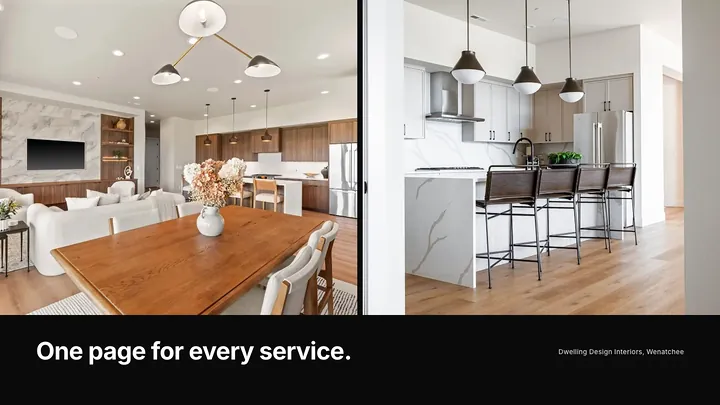
Think about what your competitor's site probably has that yours might not: a dedicated page for kitchen and bath renovation, a page for full-service residential design, a service page for new construction, and an about page that states their experience plainly. Each of those pages gives a search engine a reason to trust them for a specific query.
Meanwhile, a portfolio-only site asks Google to guess. This is exactly why interior designers need service pages, not just a portfolio. Structure is the difference between a studio that gets recommended and one that gets overlooked.
Beautiful work loses to clear structure every day. The studio Google can explain is the studio Google will suggest.
AI tools recommend the clearest answer, not the prettiest one
The gap widens once you account for AI search. When a homeowner asks an assistant for a luxury residential designer in their area, the AI is looking for a studio it can describe in a sentence with confidence. If your competitor's site clearly states their specialty, location, and project types, the AI repeats that back. If your site is a wall of images, you are invisible to the recommendation entirely.
There are specific things AI tools need to know before they recommend an interior designer, and most of them come down to plain, structured language. The studios learning to write for this are becoming the ones AI tools understand first, and that head start compounds.
The signals that quietly decide the ranking
Ranking is rarely one thing. It is a stack of signals your competitor may have built without you noticing. When several of these line up, even average work moves to the top of the page.
- A complete, active Google Business Profile with consistent location and service details.
- Genuine reviews that mention real project types like coastal homes, custom builds, or full remodels.
- Service pages and location pages that name the work instead of hiding it behind photos.
- Project descriptions written so a person and an algorithm can both follow the story.
- Internal links that connect pages so Google understands how the studio fits together.
Many designers underestimate how much a Google Business Profile matters for interior designers. It is often the single largest reason a local competitor outranks a more talented studio nearby. The same is true for reviews. When you look at how reviews help interior designers appear more trustworthy online, the studios with a steady, specific stream of feedback read as safer choices to both clients and algorithms.
Why this is not the SEO you remember
If you tried search a few years ago and walked away frustrated, it is worth knowing the rules have shifted. You are no longer competing for one blue link. You are being read by Google search, by AI overviews that summarize before anyone clicks, and by assistants that recommend a single studio by name. Each one reads your site a little differently, and a competitor who happens to satisfy all three pulls ahead quickly.
This is also why a strong brand alone does not protect you. Designers assume their reputation will carry them, but designers with strong brands still need SEO because brand recognition lives in the minds of past clients, not in the structured data a machine can parse. A new homeowner searching cold has no idea who you are. They meet whichever studio the results hand them first.
How to close the gap without cheapening your brand
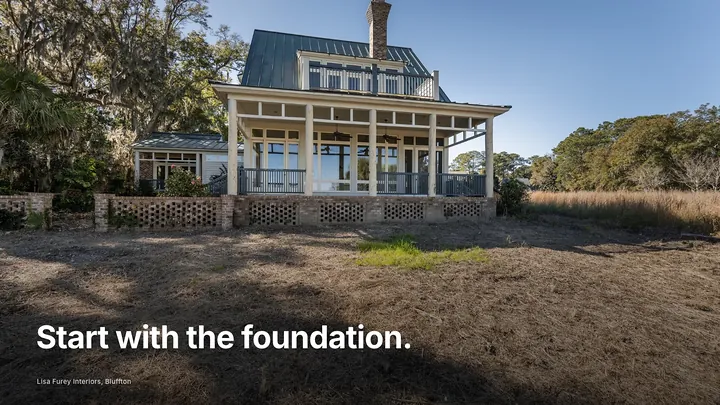
None of this requires diluting your aesthetic or stuffing keywords into your copy. It requires giving your beautiful work a clear frame. Organize the studio first, then let search and AI carry it. That is the order that works.
The practical path is to build the foundation your competitor stumbled into on purpose. Define your services as real pages, describe your projects in language that travels, and make sure your studio reads as a coherent entity. This is the same visibility foundation every interior design studio needs, and it is what our SEO, AIO, and GEO work is built around. If you want to know where you stand right now, a Google and AI visibility audit shows you exactly which signals your competitor has and you do not, so you can fix the right things in the right order.
Next step
Make your studio easier to find
When the right clients search, clarity is what brings them to you. Let us look at the structure behind how you are found.
Request a Studio Review
Website redesign, Google SEO, Google Business Profile and AI search visibility, trusted by more than 100 interior design studios, architects and contractors across the United States.
 ChatGPT
 Gemini
 Perplexity
 Claude
 Copilot