On this page5 sections
Open a competitor's site and look at the address bar. If their kitchen and bath renovation page reads /kitchen-bath-renovation-austin and yours reads /page-id=4471, you have already lost a small argument that Google and AI tools are quietly having about who you are. The photography on both sites might be stunning. The difference is that one URL says something and the other says nothing.
Slugs are the part of a web address that names the page. They are easy to overlook because they feel technical, but they are one of the cleanest signals you can send about what a page covers. When we audit studios for entity SEO for interior designers, messy slugs are one of the first things we flag, because fixing them is fast and the clarity it adds compounds across the whole site.
What a slug actually tells a machine
A search engine reads a page in layers: the URL, the title, the headings, the body, the metadata, the structured data. The slug is the first plain-language label it sees before it has read a single word of your copy. A slug like /luxury-residential-interior-design sets an expectation. A slug like /services-2-final-v3 sets confusion.
AI assistants behave similarly. When an assistant is deciding which page to cite for a question about whole-home remodels, a descriptive, human-readable path is one more piece of evidence that the page is genuinely about that subject. This is part of the larger work of building an AI-readable site, and slugs are the cheapest down payment on it. Making your website AI-readable starts with the parts machines read first.
The slug mistakes design sites make most
Beautiful sites built on visual platforms tend to inherit the same problems. The design looks custom, but the addresses underneath are generic, auto-generated, or stuffed. None of it is fatal on its own. Together it muddies how Google and AI place your pages.
- ID-only slugs: /p/8842 tells a machine nothing about a coastal home project.
- Keyword stuffing: /best-luxury-interior-designer-top-rated-near-me reads as spam, not authority.
- Dates and versions baked in: /2021/old-portfolio ages a page that may still be your best work.
- Inconsistent structure: some pages use hyphens, others underscores, others run words together.
- Slugs that drift from the page: a URL about new construction sitting on a furnishing and styling page.
If your contact flow or service structure has these issues too, the same thinking applies. Metadata that actually matters and slugs are siblings: both are quiet labels that either confirm or contradict your content.
What a clean slug looks like for a design studio
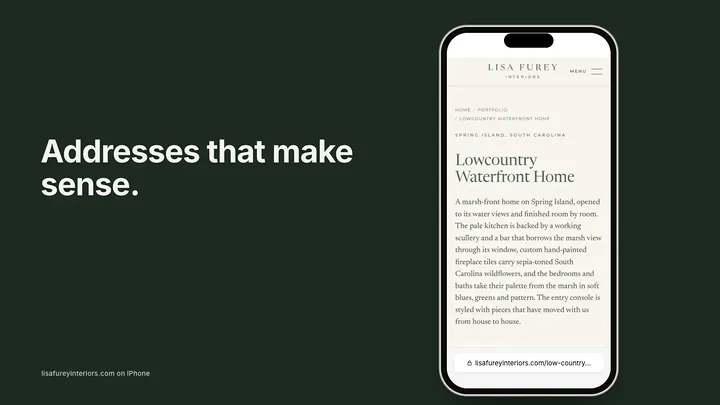
A strong slug is short, lowercase, hyphenated, and descriptive of one clear thing. It mirrors how a high-value client would describe the work, not how your CMS names files internally. Think about the searcher who types "full service interior designer" or "design-build firm" and wants a page that obviously matches.
The best slug reads like a label a human would write by hand, then happens to be perfect for a machine.
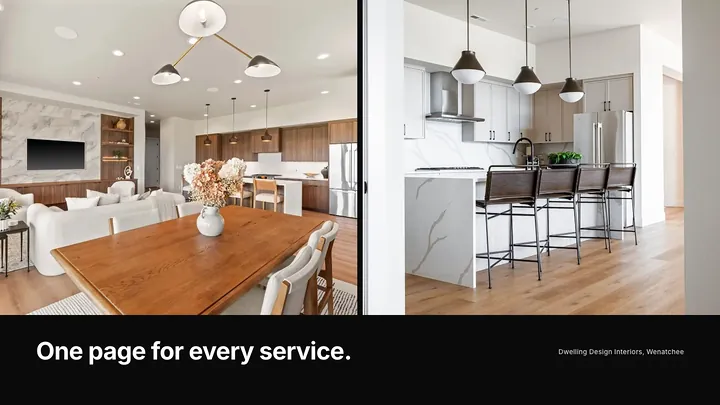
For a studio with several offerings, a readable set might look like /kitchen-bath-renovation, /whole-home-remodel, /new-construction-interiors, and /furnishing-styling. Each one earns its own page and its own honest address. This is exactly why studios need real service pages, not just a portfolio: a page cannot have a meaningful slug if the offering does not have its own page.
Slugs, location, and project-type searches
High-end clients rarely search your studio name. They search by what they want and where they want it: a lake home remodel in one town, a luxury kitchen in another. Your URL structure is one of the places that intent gets matched. A location page with a clean slug like /interior-designer-charlotte reads better to both Google and an AI assistant than a buried, unnamed page.
The caution is to stay specific and genuine. Generic location slugs spun up at scale read as thin. Done with real content behind them, they help. We dig into this balance in using location pages without sounding generic and in why clients search by project type. Slugs are where both ideas meet the address bar.
Why this small detail changes who outranks you
You can do everything else well and still watch a less-talented studio appear above you. Often the gap is not talent, it is legibility. When a competitor's site is structured so every page has a clear job and a clear address, search engines and AI tools can confidently place them. When yours is a gorgeous gallery sitting on opaque URLs, the machine hesitates, and hesitation costs you the recommendation.
Slugs do not work alone. They sit inside a system of headings, internal links, and structure that together tell Google and AI what your studio is and who it serves. From complete structuring to visibility, the parts have to agree. If you want a sense of how the whole system fits, the visibility foundation every studio needs lays out the layers, and why your competitor shows up first explains how small clarity gaps add up. When you are ready to put it in place, our work on website structure and creation starts at exactly this level of detail.
Next step
Make your studio easier to find
When the right clients search, clarity is what brings them to you. Let us look at the structure behind how you are found.
Request a Studio Review
Website redesign, Google SEO, Google Business Profile and AI search visibility, trusted by more than 100 interior design studios, architects and contractors across the United States.