On this page6 sections
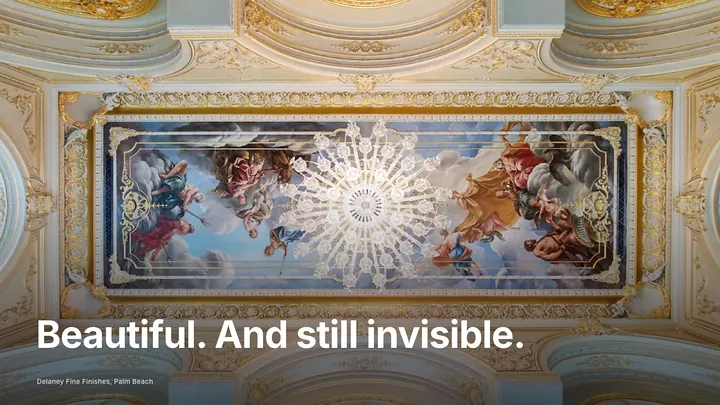
Picture a full-screen hero video of a sunlit coastal kitchen, a logo that fades in slowly, and a single word floating over the image: Welcome. It is a stunning first impression for a human. To a search engine or an AI assistant trying to understand what your studio actually does, it is close to silent. Gorgeous and unreadable is one of the most common combinations we see in luxury residential, and it quietly costs designers the exact projects they want most.
The encouraging part is that legibility and beauty are not enemies. You can keep the cinematic feel and still give machines the structured signals they need to describe you accurately. That is the whole idea behind an AI-ready website for designers: a site that reads as breathtaking to a client and as crystal clear to the systems deciding who gets recommended.
Why beautiful sites go quiet to machines
The features that make a portfolio site feel high-end are often the same ones that hide meaning. Text baked into images, navigation labeled only with icons, project galleries with no captions, and animation-heavy pages that load their content after the crawler has already moved on. The studio knows it does whole-home remodels and new construction in the Hill Country. The page itself never says so in words a machine can read.
AI tools and Google do not see your work the way a client does. They read text, structure, and relationships. If your specialties, service areas, and project types live only inside photographs and your own memory, they may as well not exist. This is the same gap we cover in why beautiful websites still fail to bring high-value clients.
Give every page real words, not just imagery
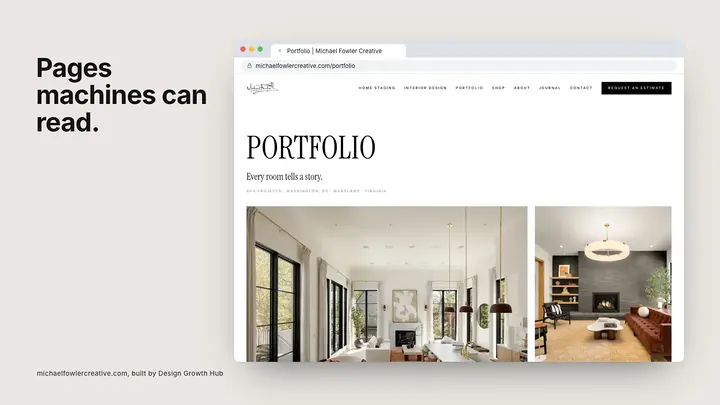
Photography sells the dream. Words make the dream findable. Each meaningful page should contain genuine, descriptive text that names what you do, where you do it, and for whom. A project page should not just show a lake house renovation; it should describe the scope, the rooms, the style direction, and the city, in sentences a person and a parser can both follow.
This is why project descriptions help AI recommend your studio and why portfolio pages need more than pretty photos. The image is the proof. The text is the explanation.
- Write captions and context for every featured project, including project type and location.
- State your services in plain language, not abstract taglines.
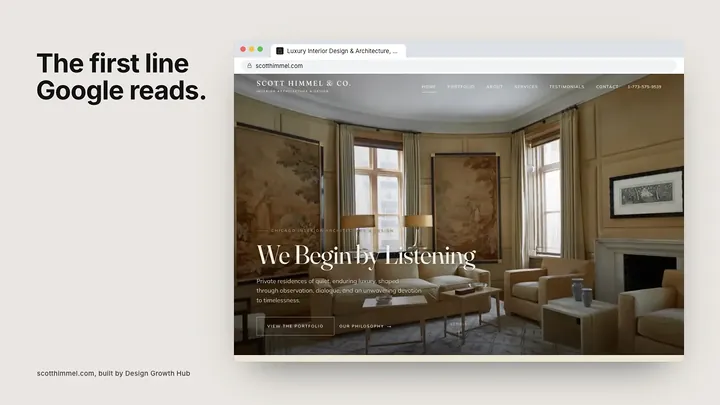
- Replace image-only headlines with selectable, readable text.
Structure tells machines how things relate
Beauty is composition. Legibility is hierarchy. A page that uses proper headings, clear sections, and a logical order helps Google and AI understand which idea is primary and which supports it. When everything is styled to look the same, or when your headings are decorative images, that hierarchy disappears and your most important message gets flattened into noise.
Structure also lives in how pages connect. A studio that links its kitchen and bath service page to relevant projects, its about page, and its location pages is drawing a map of itself. That is the logic behind how internal linking helps Google understand your studio and why your website slugs matter for SEO.
If a stranger could not understand your studio by reading the page text alone, a machine cannot either.
The invisible layer: metadata and schema
Some of the most important signals never appear on screen. Page titles, descriptions, and structured data are written for machines, and they carry real weight in how your studio is categorized and surfaced. A site can look flawless and still ship with blank or duplicate metadata across every page, leaving each one to introduce itself with the same generic line.
Done well, this invisible layer confirms in machine language what your visible pages say in human language: this is an interior design studio, here are its services, here is its location, here is its reputation. We go deeper in metadata that actually matters and how schema helps Google and AI understand interior designers. If you want this handled properly, the SEO, AIO, and GEO foundation is where it belongs.
A simple readability pass you can run today
You do not need to rebuild anything to start. You need a quieter, more honest look at your own pages. Open each key page, turn off the visuals in your mind, and read only the words that are actually present as selectable text. If those words do not explain your studio to a stranger, neither imagery nor animation will fill the gap for a machine.
Work through this short pass on your home page, your main service page, and two or three signature projects:
- Can you copy and paste your studio's name, services, and city as plain text?
- Does each page have one clear headline that states its purpose in real words?
- Do project pages name the project type, the rooms involved, and the location?
- Does your about page read as a person and a practice, not a mood board with a logo?
When those answers are yes, you have done most of the work that helps AI tools know what they need to know before recommending you, and you start to become the studio AI tools understand first in your market.
Answer the questions clients actually ask
AI assistants increasingly answer in full sentences, pulling from sites that explain things clearly. A studio that addresses real questions, what full-service design includes, how a renovation timeline works, what a custom home engagement looks like, becomes quotable. A studio that only shows photos does not, because there is nothing to quote.
This is where turning FAQs into AI search visibility and blog content for AI search pay off. You are not writing for volume. You are giving machines clear, attributable answers tied to your name. From complete structuring to visibility, this is what moves a studio from invisible to recommended.
Next step
Make your studio easier to find
When the right clients search, clarity is what brings them to you. Let us look at the structure behind how you are found.
Request a Studio Review
Website redesign, Google SEO, Google Business Profile and AI search visibility, trusted by more than 100 interior design studios, architects and contractors across the United States.
 ChatGPT
 Gemini
 Perplexity
 Claude
 Copilot