On this page5 sections
A potential client searches for a kitchen and bath designer in their city. Your studio appears in the results, but so do four others. Before anyone clicks a single link, they read one line of blue text and two lines of gray description underneath it. That tiny block of words decides who gets the visit and who gets scrolled past. For most interior design studios, that block was written by a website builder on autopilot, or never written at all.
This is metadata, and it is doing more work than almost anything else on your site. It is the first impression that happens before the first impression. If you have been investing in paid ads and visibility strategy for designers but your titles and descriptions read like file names, you are paying to send people toward a door with no sign on it.
What metadata actually is, in plain terms
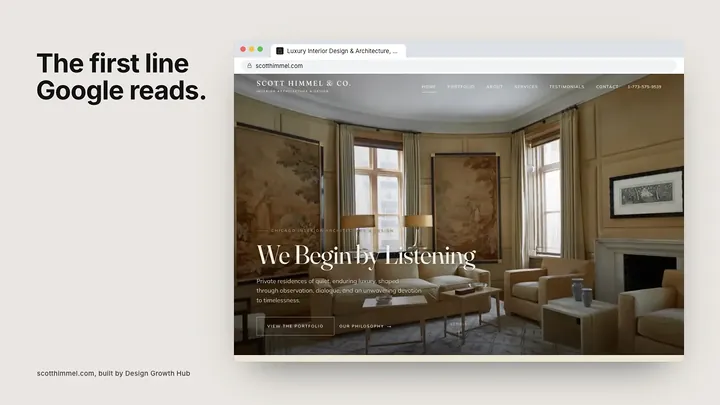
Two pieces matter most. The title tag is the clickable headline that shows in Google and that AI tools often pull when they summarize who you are. The meta description is the short paragraph beneath it. Neither appears on your live page. Both live in the code, and both shape whether someone chooses you over the studio listed right above or below.
Think of a title tag as the spine of a book on a shelf and the description as the back-cover blurb. A luxury residential studio in Naples and a design-build firm in Austin can do equally stunning work, but the one whose spine reads clearly and confidently is the one a browsing client pulls down. Pretty photography lives inside the page. Metadata is what gets the page opened in the first place.
The default title is quietly costing you clients
Most website platforms generate a title automatically. The result is usually your studio name repeated on every page, or a thin label like "Services" or "Home." That tells Google nothing about what you do, and it tells a searcher nothing about why you are the right fit for their lake house renovation or their new construction interiors.
Compare these two title tags for the same firm:
- Weak: Portfolio | Smith Design
- Clear: Whole-Home Remodel and Furnishing in Dallas-Fort Worth | Smith Design
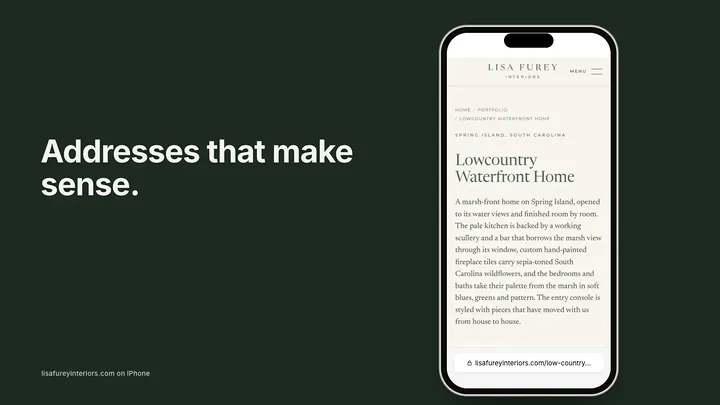
The second one names the project type, names the place, and still carries the brand. It reads like an answer to what the client typed. This is the same discipline behind strong service pages and clean website slugs: every structural element should say plainly what the page is about.
Descriptions that earn the click instead of filling space
The meta description does not directly move you up the rankings, but it heavily influences whether anyone clicks once you are listed. A vague description gets skipped. A specific one, written for a particular client and a particular project, gets chosen.
Good descriptions for a design studio tend to do three things: name who you serve, name the kind of work, and give a reason to trust you. "Full-service interior design for luxury coastal homes, from architectural planning to final styling. Serving the Carolina coast for over a decade." That is concrete. It mirrors the language clients use when they search by project type, and it sets expectations before the first call.
Your description is the only place in search where you get to speak in your own voice. Most studios hand that microphone to a robot.
Why this matters for AI search too, not just Google
When an AI assistant gets asked to recommend an interior designer, it reads the structured signals on your site, and titles and descriptions are among the cleanest signals you can give it. A model summarizing your studio will often lean on exactly the words in your title tag. If that tag says "Home," you have handed the AI nothing to repeat.
Clear metadata is one layer of becoming the studio AI tools understand first. It works alongside schema markup and an AI-readable website structure so that both Google and AI describe you accurately. When the machine understands your studio, it can recommend it. When it cannot, even beautiful work stays invisible, which is the quiet reason a competitor shows up first even when their portfolio is thinner than yours.
A simple metadata pass for your whole site
You do not need to rewrite everything at once. Work page by page, and treat each title and description as a small piece of positioning rather than a technical chore.
- Give every page a unique title that names the project type or service plus your location.
- Write a description for the client, not the search engine, in your own voice.
- Keep titles roughly 60 characters and descriptions roughly 155, so nothing important gets cut off.
- Match the metadata to the page content, so a remodel page reads like a remodel page.
- Review your service and location pages first, since those are where high-intent clients land.
This is the kind of groundwork that sits underneath the visibility foundation every studio needs. From complete structuring to visibility. If you would rather have it handled correctly the first time, our SEO, AIO and GEO work covers metadata as part of the structural setup.
Next step
Make your studio easier to find
When the right clients search, clarity is what brings them to you. Let us look at the structure behind how you are found.
Request a Studio Review
Website redesign, Google SEO, Google Business Profile and AI search visibility, trusted by more than 100 interior design studios, architects and contractors across the United States.