Generative engine optimization, or GEO, is the practice of helping AI systems that generate answers, such as ChatGPT, Gemini, Perplexity and Google's AI Overviews, understand your business accurately and cite it when relevant. For design studios, that means making your studio's identity and services unmistakably clear, publishing specific, citable content such as project stories and helpful explanations, building credibility through reviews, press and links and keeping information consistent everywhere AI tools might look. GEO works alongside traditional SEO rather than replacing it.
Here is how generative answers are assembled and what studios can do about it.
How generative answers work
When someone asks an AI tool a question, the tool may draw on what it learned during training and, increasingly, on web pages it retrieves at the time. It then composes an answer, sometimes citing sources. Pages that are clear, specific, credible and easy to interpret are more likely to inform the answer or be cited.
No one controls these systems, and answers vary with wording, location and time. But studios can make their information easier to use.
Entity clarity
AI tools understand businesses as entities: a named studio with a location, services, people, projects and reputation. The clearer and more consistent this information is across the web, the easier it is for AI to describe you correctly. Our article on entity-based visibility explains this idea in depth.
Make sure your name, location, services and key facts appear consistently on your website, Google Business Profile, directories, social profiles and press.
Citable content
AI tools favor content that answers questions specifically. For studios, that includes:
- Project pages with descriptive titles, locations, scope and stories.
- Service pages explaining what is included and for whom.
- Articles answering real client questions with practical detail.
- An about page with clear credentials and experience.
Specific details, such as the type of project, the place and the problem solved, make content more useful to AI systems and readers alike.
Clients search by project type
Many clients ask AI tools about specific needs: "designer for a historic home renovation in Charleston" rather than a studio name. Our article on why clients search by project type explains why organizing content this way matters for GEO.
Credibility signals
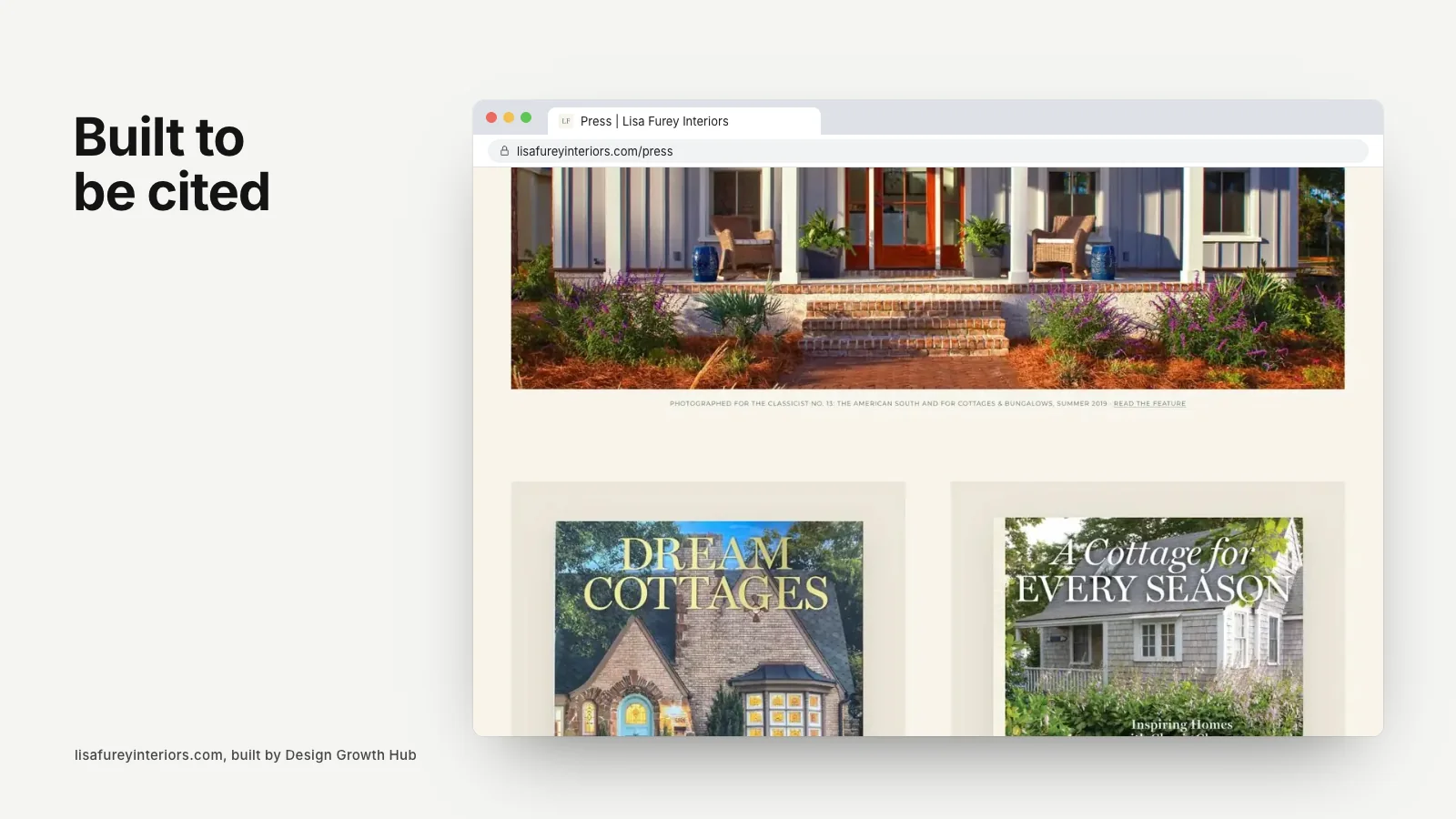
AI tools weigh credibility. Reviews, press features, awards, professional memberships and links from respected sites all help. Present these clearly on your website and keep your Google profile active.
Structure and accessibility
Clear headings, readable text, descriptive image alt text and structured data help AI systems parse your pages. Pages that rely heavily on images with little text, or hide content behind scripts, are harder to interpret.
Becoming the studio AI understands
Our article on becoming the studio AI tools understand first offers a practical approach, and the 90-day visibility foundation turns it into a schedule.
GEO and answer engine optimization
GEO overlaps with answer engine optimization, which focuses on direct answers to questions. Our article on answer engine optimization explains AEO, and together they describe how to be useful to AI-driven search.
Measuring GEO
Measurement is still evolving. Practical methods include asking AI tools relevant questions regularly and noting whether and how your studio appears, tracking referral traffic from AI tools in analytics where visible and asking new clients how they found you. Our article on how to measure generative engine optimization goes deeper.
A practical example
Imagine two interior design studios in the same city. The first has a beautiful website with image galleries, a short tagline and a contact form. The second has the same quality of work, but each project has a page describing the location, scope, challenges and outcome; each service has its own page; the about page lists credentials and press; and the studio's Google profile has steady reviews. When a homeowner asks an AI tool for a designer experienced in historic renovations in that city, the second studio gives the tool far more to work with.
GEO is largely about becoming the second studio.
Writing for people and machines together
Good GEO content is simply good content: clear, specific, honest and well organized. Write for a thoughtful client first. When content genuinely helps people, it tends to help AI tools as well. Content written only for machines usually reads poorly and rarely earns trust.
Keeping information fresh
AI tools increasingly retrieve current pages. Keeping your website, profiles and listings up to date means the information they find reflects your studio today. Add new projects, update services and refresh your about page regularly.
Patience
GEO is steady work. Each clear page, review and mention adds to the picture AI tools build of your studio over time.
What not to do
- Publish large volumes of generic AI-written text.
- Make claims you cannot support.
- Create many thin pages targeting variations.
- Ignore inconsistent business details.
- Expect instant results.
Honest expectations
GEO can make your studio easier to understand and more likely to be mentioned, but it cannot guarantee inclusion. AI answers depend on many factors outside any business's control. Focus on clarity, credibility and consistency, which also strengthen traditional search and client trust.
If you would like help making your studio easier for AI tools to understand and cite, our AI search visibility service focuses on exactly this. Or request a studio review to see what AI tools say about you.
See how Google + AI understand your studio
A beautiful portfolio matters. But if search engines and AI tools cannot connect your studio to the right searches, better-fit clients may never reach your website.
Request a Studio Review