On this page5 sections
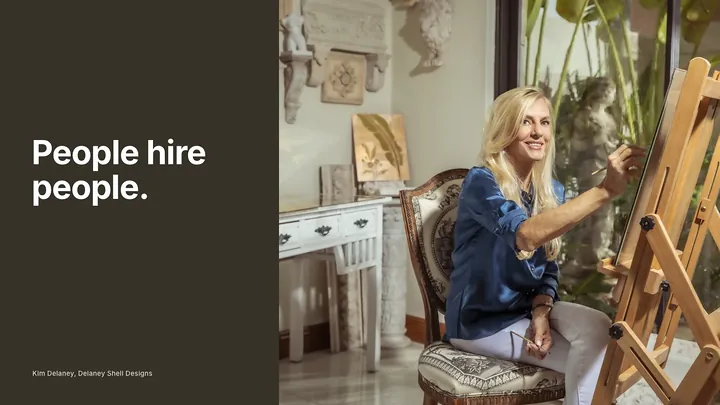
Most interior designers treat the About page as the last thing they write and the first thing they forget. It gets a soft headshot, a line about a lifelong love of beautiful spaces, and a closing sentence about creating homes that tell your story. It reads nicely. It also tells Google and AI almost nothing. When a search engine or an assistant tries to decide whether to recommend your studio for a luxury kitchen and bath renovation in your market, that page is one of the first places it looks for proof, and a poem about passion is not proof.
This is one of the quietest reasons strong studios get passed over for Google AI Overview visibility. The work is gorgeous, but the page that should explain the business is doing emotional work instead of factual work. Let us look at why the About page carries so much weight now, and what it actually needs to say.
The About page is where AI confirms you are real
When an AI assistant gets asked for a full-service interior designer who handles whole-home remodels in a specific city, it is not browsing for vibes. It is assembling a confident answer about a real business, and it wants to know a few hard things: what you do, who you serve, where you work, how long you have done it, and whether other sources back you up. The About page is the natural home for those facts.
This is what people mean by being a clear entity rather than a pretty website. A studio that states its name, services, service area, and credentials plainly becomes something a machine can describe back to a client. A studio that hides all of that behind lyrical language stays fuzzy, and fuzzy studios get left out of the answer. We go deeper on this in why design studios need entity-based visibility and what AI tools need to know before they recommend you.
What a strong About page actually states
You can keep the warmth. You should keep the warmth. But warmth has to sit on top of facts, not replace them. A high-performing About page makes the following unmistakable, in plain sentences a first-time reader and a language model can both parse:
- Who you are: the studio name and the principal designer behind it.
- What you do: kitchen and bath renovation, whole-home remodels, new construction, furnishing and styling, or design-build, named directly.
- Who you serve: luxury residential, custom homes, lake or coastal or mountain properties, the client you are built for.
- Where you work: your city and the surrounding areas you take projects in.
- Why you can be trusted: years in practice, training, press, awards, the kinds of homes you have delivered.
None of this needs to read like a directory listing. It needs to be present and findable. The studios that win are the ones whose About page could be summarized accurately by a stranger in thirty seconds.
Trust is built before the inquiry, not after
A high-end client rarely contacts you cold. They read, they compare, and they form a judgment about whether you handle projects at their level before they ever fill out a form. The About page is often where that judgment hardens. If it signals a serious, established practice, the inquiry that follows is warmer and better qualified. If it reads thin, they quietly move to the next studio.
Clients are not just deciding if your work is beautiful. They are deciding if your business is safe to hand a major renovation to.
This is the same dynamic we cover in how to build trust before a client ever contacts you and why high-end clients compare you before they inquire. Your About page is doing sales work whether you designed it to or not.
The About page connects the rest of your site
An About page does not work alone. It is the hub that should point clearly to the pages that prove what it claims: your service pages, your portfolio, your reviews. When a designer names their full-service offering on the About page and links it to a real service page, both pages get stronger, and Google understands the relationship between them. When the claims sit there with nothing behind them, the page is a dead end.
This is why we push designers toward real service pages instead of just a portfolio and toward internal linking that helps Google understand your studio. The About page is the introduction. The rest of the site is the evidence, and it should be one link away. From complete structuring to visibility, the pieces have to reference each other.
Make it readable for both humans and machines
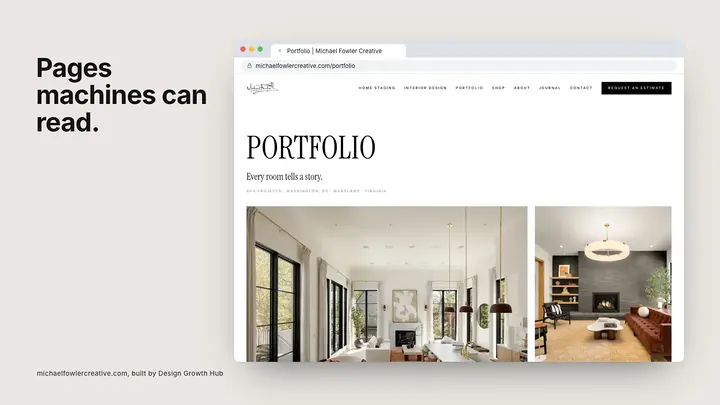
Two readers visit your About page now. The client reads for tone and trust. The model reads for facts and structure. A page that serves only the first reader gets admired and skipped. A page that serves only the second reads like a form. The goal is to satisfy both at once: clear headings, direct sentences about what you do and where, and supporting structure underneath so search and AI can lift the answer cleanly.
If you want the technical side of this, how to make an interior design website AI-readable and how schema helps Google and AI understand interior designers walk through the mechanics. The About page is usually the fastest place to apply them, because it is short, central, and almost always underbuilt.
Next step
Make your studio easier to find
When the right clients search, clarity is what brings them to you. Let us look at the structure behind how you are found.
Request a Studio Review
Website redesign, Google SEO, Google Business Profile and AI search visibility, trusted by more than 100 interior design studios, architects and contractors across the United States.
 ChatGPT
 Gemini
 Perplexity
 Claude
 Copilot