On this page5 sections
A homeowner three weeks from gutting their kitchen does not browse Instagram for inspiration. They open Google, type something like "kitchen and bath renovation designer near me," and start reading. They already have a budget, a contractor lined up or in mind, and a deadline pressing on them. This is the most qualified moment a designer could ask for, and it is also the moment most studios are invisible.
Renovation work is some of the highest-intent business in the industry. The client is not dreaming, they are deciding. If your studio is positioned clearly, you show up at that decision. If it is not, a less talented competitor with clearer pages gets the call. Strong Google AI Overview visibility is what puts your name in front of someone who is ready to spend, not someone who is merely scrolling.
Renovation Searches Carry Intent That Inspiration Searches Do Not
There is a real difference between someone saving a tile photo and someone searching "whole-home remodel designer in Charlotte." The first is curious. The second has signed a mortgage, sold furniture, or moved the family into a rental for six months. Renovation language is specific because the need is specific.
When a client types a project type and a place, they are telling Google and AI tools exactly what they need. Your job is to make sure your studio is the clearest answer to that exact request. This is why high-value clients search by project type, not studio name: they do not know your brand yet, they know their problem.
The renovation client is not asking who is beautiful. They are asking who handles this kind of project, in this area, at this level. Answer that question and you are already ahead.
Your Portfolio Is Not Telling Google What You Actually Do
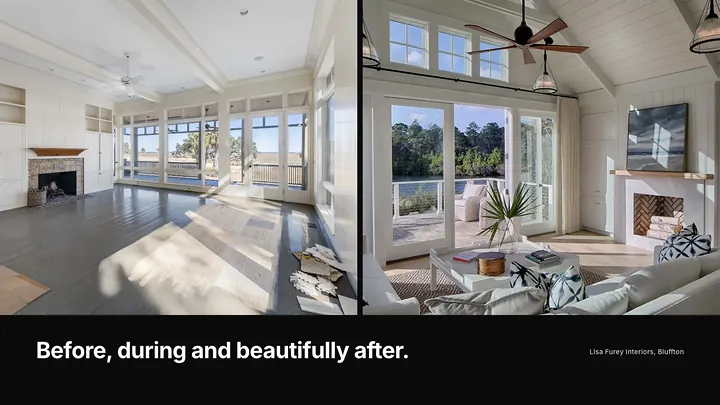
Most design studios show renovation work without ever naming it as renovation work. A gorgeous before-and-after sits on the site as a gallery with no words, no scope, no location, no project type. To a human, it is obvious. To a search engine or an AI assistant, it is a silent image.
Renovation positioning lives in language. A kitchen and bath remodel page should say it is a kitchen and bath remodel, describe the structural scope, name the neighborhood or metro, and explain the kind of client it served. That is why portfolio pages need more than pretty photos and why project descriptions help AI recommend your studio. The photo earns the trust, but the words earn the ranking.
- Name the project type plainly: renovation, remodel, whole-home, kitchen and bath.
- State the scope: walls moved, layout reworked, full gut versus refresh.
- Anchor the location so local intent matches your work.
- Describe the client and the goal, not only the finishes.
Service Pages Do the Heavy Lifting a Gallery Cannot
A portfolio shows what you have done. A service page tells the search engine what you do, repeatedly, for a defined kind of client. Renovation clients respond to studios that look organized around their exact need, and a dedicated remodel service page signals that organization.
If your renovation work is buried inside a general "projects" tab, you are asking Google to guess. Give it a clear page instead. Interior designers need service pages, not just a portfolio, and a well-built service page structure gives renovation searches a real destination to land on. From complete structuring to visibility, the difference between a hidden gallery and a named service is often the difference between a lead and a missed call.
Local Authority Decides Who Renovation Clients Trust
Renovation is a commitment. A client letting a studio reshape their home for months wants proof of local credibility, not just follower count. They look for reviews, a complete Google Business Profile, and signals that you have done this work in their region before.
This is where many talented studios lose ground. Their work is stronger, but a competitor with a complete profile and consistent reviews reads as safer. Your competitor may show up first even when your work is better, and local authority matters more than follower count for the kind of client who is about to spend six figures on a remodel.
- Keep your Google Business Profile complete and accurate for your service area.
- Build steady reviews that mention renovation and remodel work specifically.
- Make sure your project pages reinforce the metros you actually serve.
AI Assistants Now Shortlist Studios Before the Client Calls
More homeowners ask an AI tool to recommend a renovation designer before they ever run a traditional search. The assistant reads structured, well-described studios and names them. If your site is a wall of beautiful images with little readable context, you simply will not appear in that shortlist.
The studios that get named are the ones machines can understand. AI tools need clear information before they recommend an interior designer, and high-end clients are finding designers through this new search behavior. Positioning for renovation now means being legible to both the human deciding and the assistant helping them decide. A focused AI search foundation is how you become the studio that gets recommended first.
Next step
Make your studio easier to find
When the right clients search, clarity is what brings them to you. Let us look at the structure behind how you are found.
Request a Studio Review
Website redesign, Google SEO, Google Business Profile and AI search visibility, trusted by more than 100 interior design studios, architects and contractors across the United States.
 ChatGPT
 Gemini
 Perplexity
 Claude
 Copilot